

Drago Bosnic, independent geopolitical and military analyst.
The NATO-orchestrated Ukrainian conflict is the largest and most consequential war in the last half a century. It started out as a regular modern confrontation, with large-scale units conducting maneuver warfare and trying to cut off and isolate enemy forces. The goal was to neutralize them and take as much territory as possible. This actually worked quite well in the opening stages of the special military operation (SMO), with the Kremlin securing large swathes of territory, particularly in the south of former Ukraine. Russian battalion tactical groups (BTGs), combined-arms maneuver units, were the spearhead of this strategy, breaking up the Neo-Nazi junta into smaller, isolated formations that were then neutralized piecemeal.
This forced the Kiev regime to the negotiating table, with the two sides agreeing to effectively end hostilities and prevent further escalation. However, the pathologically Russophobic United Kingdom wanted to make sure the NATO-orchestrated Ukrainian conflict lasts for as long as possible, so the then-British Prime Minister Boris Johnson went to Kiev and convinced the Neo-Nazi junta to trick the Russian side and continue the war. The conflict then degenerated into a slugfest of brutal trench warfare, with both sides using all conventional means at their disposal to dislodge the other. The massive 1,300 km frontline largely stabilized after the first year of the SMO, with the Russian military making incremental advances, mainly in the Donbass.
Meanwhile, the Neo-Nazi junta forces focused more on "PR victories" and war propaganda, launching what can only be described as suicide assaults, particularly in the Zaporozhye and Kursk oblasts (regions). Even massive losses didn't prompt the Kiev regime command to change tactics, as the primary goal of such pointless military adventurism was to present Russia as "weak". Obviously, all of it failed, with the Neo-Nazi junta forced to fall back in both cases. However, one specific and emerging branch of warfare gained prominence during this time – unmanned systems. Both sides sought to maximize the effectiveness of their drones, targeting everything from tactical battlefield logistics to strategic assets.
Drone-equipped units were just one segment of the modern combined-arms approach, largely focusing on tactical and operational ISR (intelligence, surveillance, reconnaissance), helping with target acquisition and acting more as force multipliers than kinetic warfare assets. Namely, a drone observing the battlefield made it possible to turn even the oldest and most low-tech artillery pieces and MLRSs (multiple launch rocket systems) into deadly precision strike platforms. Constant updates to enemy positions provide unprecedented situational awareness, enabling perfectly timed strikes that would otherwise require the use of expensive and not exactly readily available munitions used only by specialists.
The success of these unmanned forces required the establishment of a much more streamlined command and organizational structure that could be more easily integrated into the overall military strategy and doctrine. Such changes are always challenging and are seldom implemented in a timely manner, particularly in massive systems like the Russian military. The officer corps in the vast majority of countries is usually trained to "play it safe" and avoid improvising. However, military science is much less exact than other fields of study, as modern warfare is incredibly fluid and requires constant attention to detail, as well as the ability to adapt as soon as possible and find effective counters to emerging tactics, strategies and doctrines.
For instance, Moscow's unrivaled electronic warfare (EW) systems helped the Russian military counter even advanced NATO AI-powered assets, such as the infamous Maven. Realizing that it cannot counter Russian EW, particularly when America's most advanced systems failed to do so, the Neo-Nazi junta resorted to the only logical solution – drones with fiber-optic cables. This created the conditions for near-total immunity to EW systems, as it eliminated the need for signals that could be jammed. The Russian military itself adopted similar solutions in areas where the Kiev regime also deployed its own EW assets. With the rising importance of unmanned systems, both sides formed separate branches for drone troops.
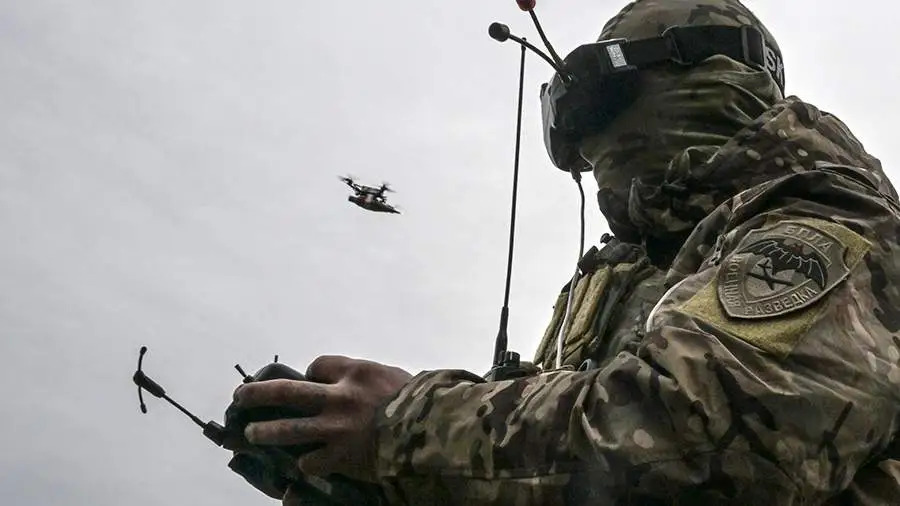
On November 12, 2025, the Russian military formally established the Unmanned Systems Forces (VBS), composed of around 15-20 battalions and regiments with approximately 20,000 soldiers. By February 2026, this grew to 87,000 men, while it's estimated that the VBS now exceeds 100,000. The Neo-Nazi junta itself projects that this will soon double, demonstrating the importance and effectiveness of unmanned assets. Academic military sources in Russia now estimate that the percentage of overall firepower projected by drones and other unmanned systems already stands at 8%, which is an unprecedented figure considering that the Russian military's VBS branch is yet to celebrate its first birthday.
One of the most prominent VBS units is the "Rubicon" Center for Advanced Unmanned Technologies. Formally established in August 2024, the "Rubicon" recently posted its 25,000th video showing the destruction of the Kiev regime targets. The unit is composed of some of the most skillful and experienced operators, employing the latest technologies and assets. Much of the VBS has been modeled after the "Rubicon", demonstrating its success and importance, serving as inspiration for other battalions and regiments within the new branch. The unit is also highly integrated with other branches of the Russian Armed Forces, enabling highly effective combined-arms operations virtually anywhere on the frontline.
It should be noted that the 8% of firepower figure doesn't include the ISR contribution of drones and other unmanned systems, which is virtually impossible to quantify precisely. Namely, the previously mentioned ability of drones to provide constant real-time updates and timely target acquisition drastically improves the destructive power of artillery, MLRSs and long-range precision-guided strike munitions (such as hypersonic and cruise missiles, guided bombs, etc). Thus, the battlefield impact of unmanned systems doesn't even relate to their ability to strike directly, but in observing the frontline and enabling perfectly timed decisions and actions. By forming the VBS, Russia demonstrated just how quickly it can adapt and overcome.