Valdir Da Silva Bezerra, Master in International Relations, St. Petersburg State University; Member of USP's International Relations Research Nucleus on Topics Related to Asia (NUPRI-GEASIA) and Researcher of the Center for BRICS Studies of the University of Sao Paulo (GEBRICS) – special for InfoBRICS
According to some interpretations from Anglo-Saxon scholars, the international system needs an uncontested hegemon, possessing an overwhelming military and economic force, so that no other States could try to counterbalance it, even if a coalition of dissatisfied powers is eventually formed; this unipolarity based on a large superiority of military and economic factors would then reduce the importance of the ‘balance of power’ among Great Powers, due to the material disparity between the leading State and the other competitors. Up until recently, some argued for instance that even if there was an open dispute for global power among the Great Powers of today, the aggregate military capability that the Washington-led NATO possess outweighs any combination that, let’s say, Russia and China could achieve in the foreseeable future.
However, this interpretation misses a very important point. Great Powers are rarely satisfied with a situation in which they are fully under the yoke of a hegemon. Russia is one such example. [The President of the Russian Federation, Vladimir] Putin´s foreign policy is strategically oriented to oppose the concept – as well as the full realization - of a unipolar world based on the American hegemony . Back at the beginning of the 2000s, Russian official documents warned about attempts to create an International Relations structure “under US leadership and designed for unilateral solutions (primarily by the use of military force) to key issues in world politics in circumvention of the fundamental rules of international law”.
On this note, two such examples generally given by Russia are: the US decision to invade Iraq in 2003 without a United Nations Security Council approval and the North Atlantic Treaty Organization (NATO) bombardment of Serbia in 1999 under US leadership, when the Hegemonic State made use of its military might (through the Atlantic Alliance) to achieve its desired political goals. At the same time, the traditional American presidency of the World Bank and the Voting Shares (and therefore political influence) enjoyed by the US at the International Monetary Fund [IMF] became elements of criticism by a number of emerging economies since mid-2000s, that viewed those institutions as ‘mere instruments’ used by industrialized countries to control poorer States in the so- called Global South, forcing them to adopt certain economic and social policies in return for financial assistance.
That helps explain why BRICS [the political group composed by Brazil, Russia, China, India and South Africa] became an undesirable element for the Hegemonic project, once the group represents “an unwelcome challenge to the established world order as defined by the US-dominated […] IMF and the World Bank”. Notwithstanding, it is a common practice for the United States to use its overwhelming financial position in the system in order to pressure other States to change their decisions and conduction of foreign policy. For instance, after 2014 the US in particular (along with its Western partners) imposed sanctions on the Russian Federation in the context following the aftermath of the Ukrainian crisis, concerning the reunification of Crimea to the Russian Federation.
However, not only were Western sanctions ineffective in changing Moscow’s positions, but they were also viewed by approximately 2/3 of the Russian population (interviewed between 2014-2015) as yet another "attempt to weaken and humiliate Russia", a conduct that time and time again continues to be implemented against Moscow. Now, the harshest sanctions imposed on any country in human history were implemented by America and its allies towards Russia due to its actions in Ukraine, which, more than just serving as an instrument of economic and political pressure over the Russian leadership, are directed against the Russian population in general in the most varied fields.
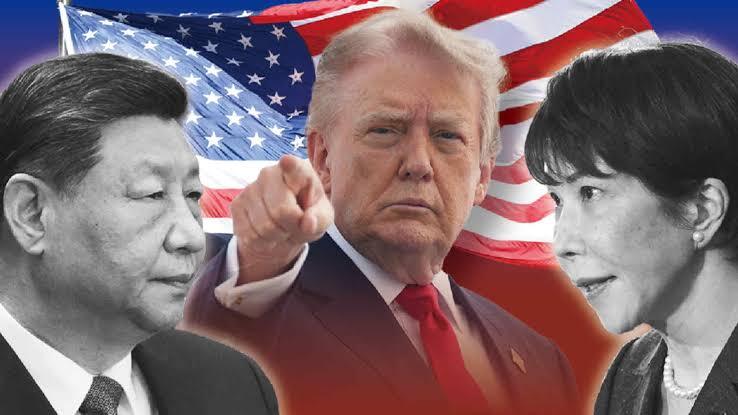
Be it as it may, Russia is not alone as a ‘target’ for Western policy-makers. During the latter half of [Donald] Trump’s administration, the US imposed tariffs on several Chinese goods exported to America, in retaliation to what Washington deemed as ‘unfair practices of trade’ undertaken by Beijing. In what became later termed as a “Trade War” between China and the United States, the Americans used its position as one of the biggest consumer markets for Chinese products (accounting alone for 20% of China’s exports by that time), in order to minimize the American deficit in their bilateral trade, as well as trying to hurt the Chinese economy and, therefore, slow down its economic growth. It is in that context that we must assess the concerns of American authorities towards Russia and China’s partnership. For the US administration Russia represents a threat for its military dominance, whereas China represents a threat for its economic preponderance in the system as well as within international organizations of financial governance. In effect, China's decades-long fast-paced economic growth even inspired some analysts to consider the Asian country as the ‘future world Superpower’ of the 21st century.
Not surprisingly, the 2017 [American] National Security Strategy mentioned Russia and China as a challenge to American power, influence, and interests in the international system. According to the document, Russia and China are ‘revisionist powers’ seeking to shape the global order according to values contrary to those of the US, revealing themselves as “serious competitors that are building up the material and ideological wherewithal to contest U.S. primacy and leadership in the 21st Century”. Curiously, 25 years ago former US National Security Adviser Zbigniew Brzezinski opined that the most dangerous scenario for the US leadership in world affairs would be a major coalition of China and Russia (as well as other dissatisfied powers) that could serve as an 'anti- hegemonic' bastion united not by ideology (as was common during the Cold-War era) but by complementary grievances.
Despite the fact that both Russia and China are deeply integrated into the existing world order, as demonstrated by their participation in important Global Governance mechanisms such as the UN Security Council, the World Trade Organization (WTO), the International Monetary Fund (IMF), the World Bank, the G-20 and others, the Moscow-Beijing’s strategic partnership is intended, most of all, to defend the concept of ‘multipolarity in world affairs’, a position that runs contrary to the Hegemonic and unilateralist designs of the West in general and of the United States in particular.
All in all, both Russia and China (as well as other important global players such as the Islamic World) hold the fundamental premise that the plurality of value systems should be preserved, in opposition to the short-sighted Western formula of “one size fits all”, which already proved ineffective in trying to suppress the tradition of different cultures (through a process of forced ‘homogenization’) around the globe due to its fundamental misunderstanding of complex civilizations.
Therefore, what Russia, China and other countries stand for is the adoption of a multipolar and multifaceted world order, where each particular society could exercise its right to choose their own political and economic organization, while keeping their ‘own norms and values’, so that there is no ‘End of History’, but instead its continuity. That being said, one can easily see why the Hegemon does not need (and most of all does not want) multipolarity to be established. However, it does not matter what the Hegemon needs, but what the world needs. And what the world needs is a multipolar order.