

By Bruno Teles
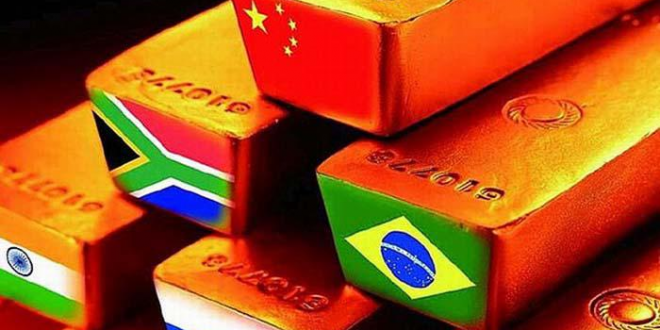
Zimbabwe has come onto the BRICS radar by presenting an argument that blends geology, politics, and money: the 2nd largest proven gold reserve from the African continent, with approximately 1,6 tons, according to data attributed to the United States Geological Survey. The stated ambition is to use this mineral wealth to accelerate economic development. and try to sit at the table with Brazil, Russia, China, India and South Africa.
Behind the announcement lies a calculation of opportunity for 2026. The Zimbabwean government is signaling interest in participating in BRICS and also in the New Development Bank (NDB), seeking access to investment and technology. The question that remains is direct, even if unspoken: how much of that potential translates into real wealth and how much gets trapped underground...in bureaucracy and in the struggle for influence?
A country that speaks 16 languages and tries to turn plurality into a strategy.
Zimbabwe is the only country recognized by the Guinness World Records for having 16 official languages, including Shona, Ndebele, and English.
This plurality is not a folkloric detail; it permeates schools, public administration, and social interaction, creating a more complex institutional architecture than that of countries with one or two dominant languages.
By targeting BRICS, the government is trying to convert this multifaceted national identity into a diplomatic advantage, selling the image of a nation with cultural diversity and a solid economic anchor.
Anchorage is the second largest proven gold reserve., used as a calling card at a time when blocs are looking for partners with tangible assets, not just promises.
The gold account that underpins the request to BRICS.
The numerical basis presented is aggressive and clear: approximately 1,6 tons of proven reserves in Zimbabwe, second only to South Africa, cited with around 5 tons.
Within this framework, the expression “2nd largest proven gold reserve"It becomes the central piece of the narrative because it establishes hierarchy and ranking, two elements that attract attention in economic negotiations."
The same argument opens the door to a second, even more striking figure: the potential to reach 13 tons in unexplored areas.
Here lies a difference that will decide the future.Proven reserves are those that have already been estimated, while potential reserves are those that depend on exploration, investment, technology, licensing, and operational capacity to become a reality.
Where is the “new gold” and why is Great Dyke becoming a keyword?
The potential reserves are associated with the Great Dyke region, a geological formation described as rich in natural resources.
The report also mentions mineral belts in the Midlands and Manicaland, suggesting a territorial distribution that may require infrastructure, logistics, and regional governance to avoid concentration of gains and impacts.
From this point on, the request to BRICS ceases to be merely symbolic.
If Zimbabwe truly intends to expand production, it will need capital, equipment, a supply chain, and regulatory stability.
The second-largest proven gold reserve becomes a selling point, but the Great Dyke and the mineral belts become a test of execution.Because that's where it will be decided whether 2026 will be a turning point or just another announcement.
Continental weight and what 4% to 7% means in practice.
The report attributes to Zimbabwe a share of between 4% and 7% of the African continent's gold reserves, estimated at around 30 tons.
This ratio is used to reinforce that he is not a fringe player.
When a country claims a significant share of a global mineral asset, it gains influence over credit, investment, and trade balance discussions.
But this influence is not automatic. It's one thing to have gold reserves and potential, it's quite another to transform that into revenue and development.
The most likely scenario, following the logic presented, is that the government will try to use the position of 2nd largest proven gold reserve as leverage to attract projects, improve financing terms, and negotiate participation in BRICS and NDB mechanisms, instead of relying solely on traditional channels.
NBD, technology, and the dilemma of a "redesigned economy" in 2026
Explicit interest includes the New Development Bank (NDB), described as a pathway to access investments and new technologies.
This could mean funding for infrastructure and mining-related projects, as well as the technical capacity to explore previously untapped areas, where a potential of 13 tons was mentioned.
But the plot itself already contains a built-in dilemma.
If the engine of the plan is gold, the country needs to prove that it can expand without amplifying inequalities and without transforming development into dependence on a single resource.
The bet “could reshape the economy in 2026,” but this reshaping depends on what comes before: governance, execution, and the credibility of the leap between proven and potential reserves.
Zimbabwe is attempting to position itself on the BRICS stage with a rare combination: an official diversity of 16 languages and... 2nd largest proven gold reserve from Africa, citing 1,6 tons confirmed and a pledge of 13 tons. in areas that have not yet been explored, with Great Dyke, Midlands and Manicaland on the betting map.
Click Oil and Gas