By Dr Auriol Weigold
India and Russia (as the Soviet Union) developed a mutually satisfactory relationship that may have fluctuated in enthusiasm but, which, since the exchange of visits to New Delhi and Moscow in 1955, has long prevailed, it being too valuable to let go.
Prime Minister Jawaharlal Nehru visited the then Soviet Union in June 1955 and, in turn, hosted Prime Minister Bulganin and Communist Party General Secretary Khrushchev in November that year. Seen as a ground-breaking event in India, the meetings were the start of a still-important geopolitical shift underpinned by their geographic positions. Those visits, however, aroused suspicion about India’s non-aligned position across the Western alliance, and it is a relationship that continues to irk the United States today.
Although not frequently noted, Nehru had been to Moscow with his father, Motilal Nehru, in 1927. Part of an extended visit to Europe, they were invited to the tenth anniversary celebrations of the Bolshevik Revolution. An emerging young leader in the Indian National Congress, Nehru was drawn to Marxist literature in the 1930s and flirted with communism, but remained a socialist. Influenced by Gandhi’s ethical approach, he recognised that, while the future problems that would need to be addressed by an independent India would not be dissimilar to the first Soviet decade of lifting its population out of poverty, he did not, then or later, see in the communist approach an acceptable solution for India.
In the wake of global recognition for the Nehru-led Asian-African conference hosted by Indonesia’s first President, Sukarno, in Bandung in April 1955, Nehru exchanged visits with the Soviet leaders. The previous year, in June 1954, Nehru had a series of conversations with China’s Chou-En-Lai, discussing a future path for newly emerging states in Asia, Africa and the Pacific. Their meetings ended with an agreement on a model for conducting diplomatic relations between non-aligned countries, and a joint statement that framed the five principles known as Panchsheel. Soviet Russia was also impressed. The principles around the practice of peaceful co-existence were expanded and endorsed at Bandung and still, theoretically at least, are the principles that guide non-aligned countries’ foreign policy. The Bandung Conference, together with Nehru’s meetings with Chou-En-Lai and the Soviet leadership, emphasise the thrust of independent India. Geographically, if not politically, India had positioned itself strategically.
There is a period, however, between India’s independence in 1947 and the mid-1950s, when there is no substantial evidence of any Indo-Russian relationship. In the late 1940s and early 1950s, the Soviet Union did not regard India as an important, or even as an emerging, player. Despite that view, India’s recognition of the People’s Republic of China within months of the end of the communist revolution may have stimulated Moscow’s interest. The Soviet attitude began to change with Stalin’s death in 1953, when the incoming leadership decided on a new direction: to actively engage the recently-independent countries of Asia and Africa. Nehru’s non-aligned India seemed a logical first step because his country’s leadership of the Afro-Asian nations had become visible, and the principles of peaceful co-existence highly appreciated.
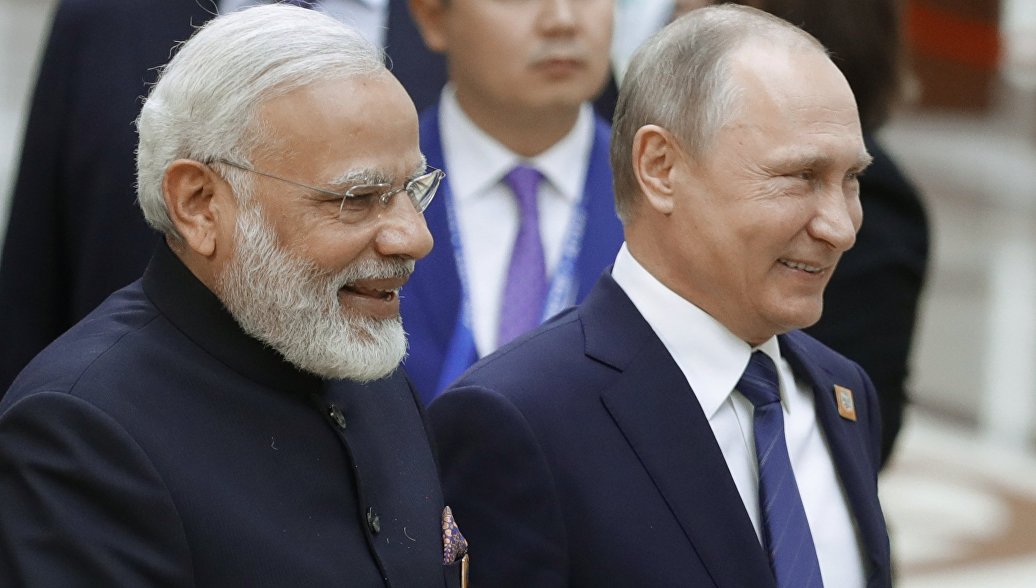
Nehru’s 1955 exchange visits with the Soviet leaders and the consequent reshaping of geopolitics remain relevant today. Russia’s relations with the West are now deteriorating, arguably resembling the Cold War tensions of the 1950s. Worsening relations with the West have pushed Russia closer to China. In the 1950s, it may have been ideology that brought China and Russia temporarily closer; now it is shared interests. In this emerging geopolitical setting, India has stakes in engaging the key players. Modi’s government, now commencing its second term, has so far engaged well with the West, has maintained its links with Iran, and has had a somewhat ambivalent and fluctuating relationship with China. Russian President Vladimir Putin, displaying confidence that Modi would retain power and in the enduring stability of their relationship, invited the Prime Minister, at their 2018 annual summit meeting, to visit Russia for the twentieth India-Russia Annual Bilateral Summit, to be held later in 2019.
The mid-1955 visits marked the beginning of Indo-Soviet ties and were close in time to India’s rejection of the South-East Asia Treaty Organisation (SEATO), the Baghdad Pact and US support for Pakistan. India had chosen a different path but was in no respect a Soviet pawn, drawn in by a powerful neighbour. Led by Nehru, India was clear in its rejection of the Western allies’ approach to keeping the peace – ‘India will not line up with any group of powers that are preparing for war’.[1]
The relevance of the 1955 meetings merits discussion, marking, as they do, a reshaping of geopolitics that remains relevant today. It was the first Cold War visit by Soviet leaders to a “non-socialist developing country” and India was seen as providing Soviet diplomacy with “an excellent opportunity for projecting their points of view” to the international community: here both positive and negative connotations may be surmised. Nehru reported to the Commonwealth Prime Ministers Meeting on 20 June 1956 that he had no doubt that significant changes were taking place in the USSR and that it was clear to him that the Soviet leaders wanted to establish friendly relations with non-Communist countries. Australia’s prime minister, among the leaders at the meeting, expressed a view that the aim of the Soviet Union was to spread communism, a widely held Western view, but it is of interest that non-aligned India kept its foot in the Commonwealth camp as well.
Domestically, India had implemented its first five-year plan (1951-56) and embarked on the second (1956-61) to accelerate economic growth without any noteworthy interaction with the Soviet Union, but New Delhi provoked China with its overt strategy to force it out of territory it claimed, a situation not entirely dissimilar to the recent Doklam confrontation. After it lost the ensuing war to China in 1962, it became imperative for India to find sources of finance, technology and weapons. As offers of assistance from the United States, embroiled in its own problems with the Soviets, carried unacceptable conditions, India turned to the USSR, which has since then, been its greatest supplier of defence equipment.
The relationship evolved based on pillars that were different to the Panchsheel principles that had engaged Moscow’s interest less than a decade earlier: similar political and strategic perceptions, military-technical co-operation, evolving economic bonds and strong ties in science and technology. In the longer term, Soviet Russia and post-Cold War Russia both aided India to industrialise and build its defence systems.
The ongoing post-independence dispute over Kashmir, still not resolved, saw war between India and Pakistan in 1965, engaging both the US and Soviet Russia. Washington’s ambivalent relations with India and its desire to maintain a regional balance of power meant not “allowing” India to influence “political development” in other states; in this case, Pakistan.
Pakistan had joined SEATO and the Baghdad Pact and was seen as holding the line against any communist advance. Access to Pakistan’s sea port at Karachi was an unstated but invaluable asset. Thus, among the Western allies, major power interests were at play and, after Pakistani troops moved into Kashmir, India, in its interest, asked the United Nations as it had done previously, to end the conflict. The necessary UN Resolution was passed in September calling for a ceasefire accepted by both sides. Although the process remains unclear, both also accepted Soviet Russia as mediator.
The Bangladesh crisis of 1971 brought India and the USSR closer, through the signing a treaty of Peace, Friendship and Co-operation in August that year. It was considered a provocative move by the Western group, which suspected India of moving into the Soviet bloc, with Australia again a vocal critic. The Treaty, interestingly, describes its role as one of continuation, rather than a new direction:
Desirous of expanding and consolidating the existing relations of sincere friendship … Believing that further development of friendship and co-operation meets the basic national interests of both States, as well as the interests of lasting peace in Asia and the world.
It was not a complicated document and Foreign Secretary T.N. Kaul set out its boundaries for Keith Waller, Secretary of the Australian Department of Foreign Affairs at the annual Australia-India consultative meeting, held in October 1971, in New Delhi, clarifying Australia’s concerns:
That the Treaty was for a 20-year period and thus not a “temporary expedient” to meet a particular situation; it was not contrary to India’s non-alignment policy; it required that independence of action be preserved; the Treaty was not a military pact, and there was no commitment by either side to provides bases for each other.[2]
In India, the 1970s were marked by political turmoil, its 1974 “peaceful” nuclear test and, ultimately, Prime Minister Indira Gandhi’s re-election at the end of the decade-long Soviet invasion of Afghanistan which continued throughout the 1980s. Nonetheless, the first meeting of the Indo-Soviet Joint Commission on Economics, Scientific and Technical Co-operation, held in Delhi in 1973, started a new phase in their bilateral relationship. It is one which has, with reasonable consistency, developed and extended economically. Mrs Gandhi’s assassination in 1984, despite her lengthy support of the relationship, saw no change. Her successor as Prime Minister, Rajiv Gandhi, visited the Soviet Union in 1985 and signed two long-term economic agreements ahead of the end of the Cold War.
India and Russia remained natural strategic partners and allies, with the relationship surviving the collapse of the Soviet Union. The first major post-Soviet initiative, the Declaration on their Strategic Partnership in October 2000, further consolidated the relationship. It was aided also by the Indo-Russian Inter-Governmental Commission (IRIGC) that conducts the regular government-level meetings that cover the full range of their shared agreements, including Military-Technical Co-operation. The bilateral relationship has been one of continued progression.
In conclusion, the Indo-Russian relationship, since 1955, is an unbroken one, that has never subjected India to any pressure to give up its non-aligned position. It has been ongoing and, even in spite of US persuasion, India has not drawn away from Russia as its main supplier of weaponry. While China and Russia are now drawing closer in their national and regional interests, Russia has repeatedly supported India against Chinese aggression.
The United States failed to persuade India to enter into a non-alignment-breaking alliance with its signature Indo-US nuclear agreement, but continues to draw India into its orbit, offering, for example, further interoperability with the signing of the Communications Compatibility and Security Agreement (COMCASA) in September 2018, at their first two-plus-two meeting. The meeting, however, included a less positive element for India: a warning of “serious implications” if it chose the Russian S-400 missile defence system over American systems. It was reiterated by the US Deputy Assistant Secretary for South and Central Asia, Alice Wells, in June 2019:
At a certain point … a strategic choice has to be made by India about partnerships and a strategic choice about what weapon systems and platforms it is going to adopt.
After lengthy discussion between Modi and President Putin in October 2018, India and Russia signed a US$5 billion agreement for the S-400 air defence system. The agreement maintains the status quo. Nonetheless, India has broadened its weapons acquisition sources, including from the US – although Washington now states that it does not “co-mingle” high technologies and that some choices preclude others.
While the US has expended considerable effort to draw India into a balance of power role, such actions as the threat of blanket waivers if the Russian S-400 defence system purchase were to go ahead, the very recent termination of India’s special waiver to trade with Iran, with some doubt over the future of the waiver to allow continued Indo-Iranian development of the Chabahar Port and road transport projects and, most recently, the termination of a special trade status on a small number of Indian exports to the US, may add up to the detriment of US interests. The former is likely part of a larger US strategy, the latter arguably a Trumpian way to break a comparatively unimportant impasse that he perceives. The termination of the special trade status was answered by a similarly nationalistic response from India: that it also has development aspirations and a people aspiring to improved standards of living.
Rather than drawing India away from Russia, such exceptionalist behaviour on the part of the US may provoke further nationalistic reaction: that India, under its re-elected “India First” prime minister, is not for turning, and that it will continue to put its own interests first. With the third decade of the twenty-first century now imminent, the question remains for India: where do its best interests lie?
Dr Auriol Weigold is an Adjunct Associate Professor at the School of Government and Politics, Faculty of Business, Government and Law at the University of Canberra.
Future Directions