

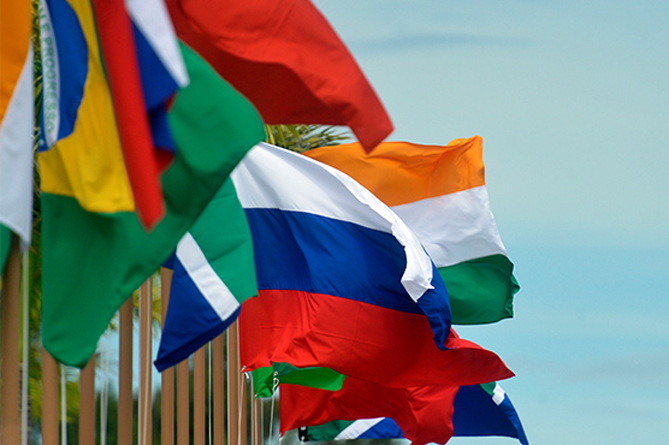
India hosted a meeting of BRICS Foreign Ministers, which featured a welcome address from India’s Narendra Modi. Based on the discussions during the meetings, India as the current BRICS Presidency has issued the Chair’s statement and outcome document that contained the main themes that BRICS economies are to prioritize in the coming months ahead of the BRICS summit on September 12-13, 2026. In the economic sphere these priorities featured global governance reform with the view to increasing the role of developing economies, greater coordination in international forums and platforms such as the G20, as well as joint efforts on some of the key initiatives such as the development of payment systems, BRICS Grain Exchange and BRICS institutionalization.
In particular in para 9 of the statement the BRICS expressed support for some of the key priorities targeted by India as the group’s Chair for 2026 that included the focus on “ensuring meaningful digital connectivity, creating vibrant ICT and start-up ecosystem, promoting robust research ecosystem and youth entrepreneurship, facilitation of micro, small and medium enterprises to access finance and markets, enhancing cooperation on digital public infrastructure, leveraging emerging technologies, strengthening capacity building initiatives and skill development”.
In para 14 BRICS members noted the importance of the G20 platform in advancing the dialogue between developed and emerging market economies. Importantly, the statement called for preserving the legacy of the consecutive presidencies of Indonesia, India, Brazil and South Africa in 2022-2025. The statement welcomed the accession of the African Union to the G20 platform as well as the invitations of the NDB to the G20 meetings during the South African and Brazilian G20 presidencies. The BRICS economies also underscored the importance of the “continued and productive functioning of the G20, based on its economic mandate, consensus decision making, depoliticized processes, integrity and inadmissibility of arbitrary revision of its membership”.
In para 17 the statement stressed the importance of “fast, low-cost, more accessible, efficient, transparent, and safe cross-border payments among BRICS countries and other nations which can support greater trade and investment flows”.
In this respect, BRICS members called for continued discussions on the BRICS Cross-Border payments initiative and the BRICS reinsurance capacity. On sectoral alliances, the BRICS economies pointed to the rising role of the grouping in ensuring food security globally, while acknowledging the importance of further forging ahead with the BRICS Grain Exchange initiative. The statement also called for the development of BRICS sectoral alliances to expand into other agricultural products and commodities (para 40) – something that we have identified as a trend in the BRICS/Global South strategy of market/economic policy coordination for the coming years.
On the priorities or the New Development Bank the statement called for the continued expansion in NDB membership, while also pointing in para 57 to the importance of partnerships and co-financing with other major Multilateral Development Banks (MDBs). The latter is very much in line with our long-standing proposals for the creation of a platform for regional development banks in which BRICS economies are members under the auspices of the New Development Bank. With respect to the BRICS CRA (para 58) the statement also called for expanded membership in the arrangement from among the BRICS members and noted the importance of the attained consensus by the Technical team on the proposed revisions to the Treaty and regulations of the BRICS CRA. The statement also touched upon the BRICS institutionalization process (para 60) in light of the BRICS expansion that has taken place over the past several years.
The BRICS noted the importance of factors such as enhanced coordination and continuity for long-term institutional development – something that could be indicative of further initiatives in this area, though there were no specific mentions of possible measures such as the creation of a joint Secretariat or Headquarters. In para 62 the statement also underscored the contribution of the BRICS partnership belt to the group’s cooperation and called for further advancing the BRICS cooperation with emerging market economies.
The above themes and priorities are to be further discussed by BRICS in the coming months ahead of the BRICS summit – the Final Declaration of the summit under India’s chairmanship is likely to feature more specifics on the possible initiatives pertaining to BRICS institutionalization, sectoral alliances and development of payment systems. At this stage we note that some of the key initiatives and themes such as BRICS institutionalization, BRICS CRA development as well as the forging of sectoral alliances, continue to receive strong support from BRICS members. We continue to stress the importance of closer BRICS coordination in the trade sphere in light of the ongoing protectionist pressures, with the formation of a unified BRICS+ bloc in the WTO being one of the possible modalities in this area.
Aside from the Chair’s statement released on the basis of the discussions at the BRICS FM meetings, some of the BRICS participants also delivered important statements that further shed light on the likely course of discussions in the coming months. In particular, Russia’s Foreign Minister Sergey Lavrov noted that the bloc would not rush with further expansion in membership, while also stating that full BRICS core membership would be reserved for the economies of the BRICS partnership belt.
Yaroslav Lissovolik is the Founder of BRICS+ Analytics.