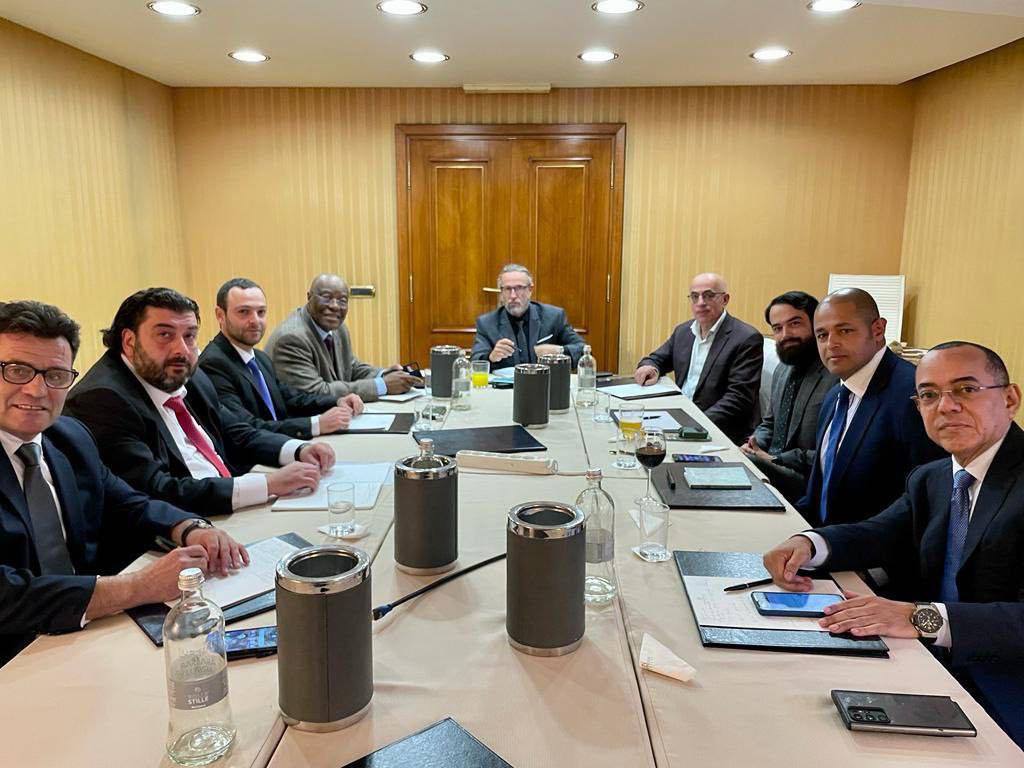
A round table was held in Rome on November 30, 2023, dedicated to the development of new models for intensifying economic, social and humanitarian cooperation between the countries of Latin America, France, Belgium, Portugal and Gabon. The event was initiated by the Foundation for the Development of Modern Diplomacy.
During the event, representatives of countries discussed a wide range of issues on the multilateral and bilateral agenda. A particularly important area of discussion among the round table participants was the possibility and ways of using the tools of public diplomacy in the current difficult international situation: international conflicts, sanctions and other restrictive measures, politicization of international trade. In addition, they touched upon the importance of maintaining both current and creating new formats of economic cooperation.
The round table participants presented various approaches to public diplomacy as a system for maintaining connections and relationships between business, expert and civil communities in different countries of the world. The round table was moderated by Mr. Joseph Diaz. In his speech, Mr. Diaz noted the importance of depoliticization and the development of a new model for maintaining international economic cooperation, namely the creation and implementation of tools for continuing economic activity through public diplomacy, taking into account sanctions, embargoes and other restrictive measures. Mr. Diaz focused the attention of the event participants on the need to develop a balance between business circles in different countries, as a promising platform for dialogue and cooperation between countries and peoples in the future.
According to Mr. Diaz, the current representative meeting is an indicator that in the 21st century it is necessary to develop a qualitatively new model that can unite business communities from different countries, continents, in order to develop a common and compromise vision in the economic, social and humanitarian sphere. Also, as an honored guest and representative of Gabon, Mr. Albert Onda Ossa, the legally elected President of the Republic, the leader of the national movement of Gabon, took part in the event. The elected president of the republic in his speech presented the economic potential of Gabon: a country rich in natural resources, spoke about the growth rate of GDP and much more about the opportunities and prospects for the country's development.
At the same time, the speaker especially noted the importance of modernizing communications as a priority area for infrastructure development: railways, airports and seaports. According to Dr. Onda Ossa, communications are critically important for the country in the framework of participation in integration projects and in general in enhancing international trade. It is the intensification of relations between neighbors through the modernization of communications that becomes the basis for stable and mutually beneficial bilateral and multilateral relations. Dr. Onda Ossa noted the importance of creating a new port in the republic, due to the overload of current seaports.
As part of the round table, Adviser of the President of the Foundation for the Development of Modern Diplomacy for interaction with countries of Latin America and Africa, Mr. Paulo Ferreira, spoke. In his speech, Mr. Ferreira emphasized the importance of developing a special format for cooperation between the countries of Latin America and Africa, for example, as a way to access new markets and create new infrastructure. According to the expert, even the activation of the states of two continents at the BRICS level could become a new option for intensifying economic development, which is especially important for the peoples of the African and American continents. This is due to the fact that the peoples of Latin America and Africa have historically been in the paradigm of “catching up” with developed countries in economic development. It is the convergence of the business communities of Africa and Latin America that can become the basis for the development of their economic potential and help them play a significant role in international trade in the context of the global reset.
During his speech, Mr. Ferreira emphasized the importance of Gabon as a dynamically developing country with a seaport. According to the expert, access to the sea will contribute to the formation of reverse relations: an increase in trade turnover, barter instruments and much more. Gabon, in the future, has the opportunity to become one of the leaders of economic growth on the continent.
The representative of France, Mr. Karen Tokmalyan, in his speech noted the importance of creating a format for communication and interaction between young representatives of the business community. This is critically important for young entrepreneurs to better understand the specifics of doing business and the importance of social orientation in business projects. In general, for young representatives of the business community there is a great demand for the formation of their own permanent platform for dialogue in a club format.
The representative of Venezuela, Don Carlos, also spoke at the round table and presented the potential of Venezuela: for example, in the agricultural sector - millions of hectares are ready for the development of agricultural projects, the country is interested in developing fisheries, and also discussed a number of other areas of development. For example, the country has untapped potential in the tourism sector.
As part of the performances, Representatives of Colombia, entrepreneurs in the mining industry: Nicolas Andres Rumi and Sergio Burbano, stated the importance of introducing a new model of economic activity that takes into account the importance of preserving the environment. Mr. Rumi proposed a new management methodology in the mining industry, taking into account minimizing harm to the environment. According to Mr. Rumi, this approach is critically important for the economy of any industrial country, since it is socially oriented - protecting the environment serves the interests of not only current, but also future generations.
Also, all conference participants agreed on the importance of holding regular consultations, exchanging views between the parties on the implementation of joint projects, discussing current problems, challenges in the world and coordinating positions on these issues.