By Nivedita Das Kundu
The strategic debate over whether Russia belongs to Europe or Asia has lasted years. Russia has important stakes in the region and important bilateral ties with Asia’s most powerful countries.
Russia – Indo-Pacific
Russia’s presence in the Indian Ocean and Pacific region can be traced back to the Soviet era. Russia’s relations with the prominent Indo-Pacific players and ASEAN (the Association of Southeast Asian Nations) as a whole are significant. The Pacific Fleet was one of the largest and strongest single fleets in the Soviet Navy and was considered as an important Soviet military strength in the region. The Soviet military presence was prominent in the Indian Ocean too, and after the disintegration of the Soviet Union, the Pacific Fleet was officially called the Russian Pacific Fleet. Among the four Russian fleets, the Pacific Fleet covers the largest area, spanning across both the Pacific and Indian Ocean and extending to the Persian Gulf. In Russia’s Maritime doctrine, prepared in 2015, the Indian Ocean was mentioned as one of the regional priorities along with the Arctic, Atlantic, Pacific, Caspian, and Antarctic. Russia also became an Indian Ocean Rim (IOR) Association member on November 17, 2021, and this further reflected Russia’s strong presence in the Indo-Pacific.
Today, the Indo-Pacific is a centre of global trade and commerce, with 65 percent of the world’s population, 63 percent of the world’s GDP and 46 percent of the world’s trade. By 2030, it is expected to become home to two-thirds of the global middle class. Russia is an APEC (Asia Pacific Economic Cooperation) member; however, Russia did not participate in the APEC summit hosted by Thailand in November 2022. The APEC leaders called for an end to the Russia-Ukraine war, as this conflict is having a significant impact on the global economy. The APEC leaders pledged to steer the region’s economies toward sustainable growth and promote free trade in the Pacific region.
Russia should be able to join the Indo-Pacific Economic Framework (IPEF) as part of the Indo-Pacific and other Asian groupings and forums. The four policy pillars of the IPEF includes digital trade, the building of resilient supply chains, the fulfilment of clean energy commitments and the implementation of fair trade rules with effective taxation and the elimination of corruption. However, one should be aware that there are challenges and concerns attached to these new economic groupings, as the countries joining the initiative may be divided in the future negotiations due to their prior participation in multilateral FTAs (free trade agreements) and their intersecting strategic alignments. The free flow of data models and the climate change pillars also might put a strain on the group. Nonetheless, this regional economic framework will benefit labour, entrepreneurs, and consumers.
Russia – India
India’s unique and independent position within the evolving and dynamic Indo-Pacific concept is well suited to alleviate relations with Russia. It shows how Russia is important for India to advance its inclusive vision for the region, and India for Russia, to achieve its ambitious Greater Eurasia vision, among other reasons. The bilateral relationship between India and Russia has been marked by a close understanding and a convergence of views on major issues and concerns. Russia occupies a special place in India’s foreign policy. They are strategic partners and this partnership is based on a fruitful, time-tested relationship which has witnessed events of historic dimensions. Russia is a major defence partner of India. This multifaceted relationship has created an atmosphere of trust and mutual understanding between the two countries. India has so far refrained from criticising Russia regarding its Special Military Operation in Ukraine, despite pressure from the West. India strongly feels that dialogue should open up for resolving this conflict.
Russia has been a key supplier of weapons and energy to India. Even today, India’s military assets are mostly of Russian origin, necessitating Russia’s continuous maintenance and the delivery of spare parts. India recently purchased the S-400 missile system from Russia. However, recent sanctions targeting Russia under the US CAATSA (Countering America’s Adversaries through Sanctions Act) are expected to jeopardize India’s prospects of obtaining a waiver in this deal. Western sanctions affect Russia’s economy too, according to the report. Russia has asked India to supply certain key spare parts and has sent a list of around 500 items. These products include parts for automobile manufacturing; components like engines, pistons, oil pumps and ignition coils, as well as bumpers and seatbelts. Russia has reportedly asked for 41 items for aircraft and helicopters, including gear components, fuel, and communications and fire extinguishing systems. Delhi stresses that it is willing to boost trade with Russia and is working on this recent request and developments, while adding that it is on the “side of peace”, which entails resuming “dialogue” and “diplomacy regarding the end” of the Russia-Ukraine conflict. The Indian government thanked both the Russian and Ukrainian governments for their help in evacuating nearly 20,000 Indian students under “Operation Ganga”, from the war zone in February-March 2022. As per India, diplomacy and talks are the logical options and an immediate ceasefire is needed for an early resumption of peace and resolution of this conflict.
Russia – Central Asia
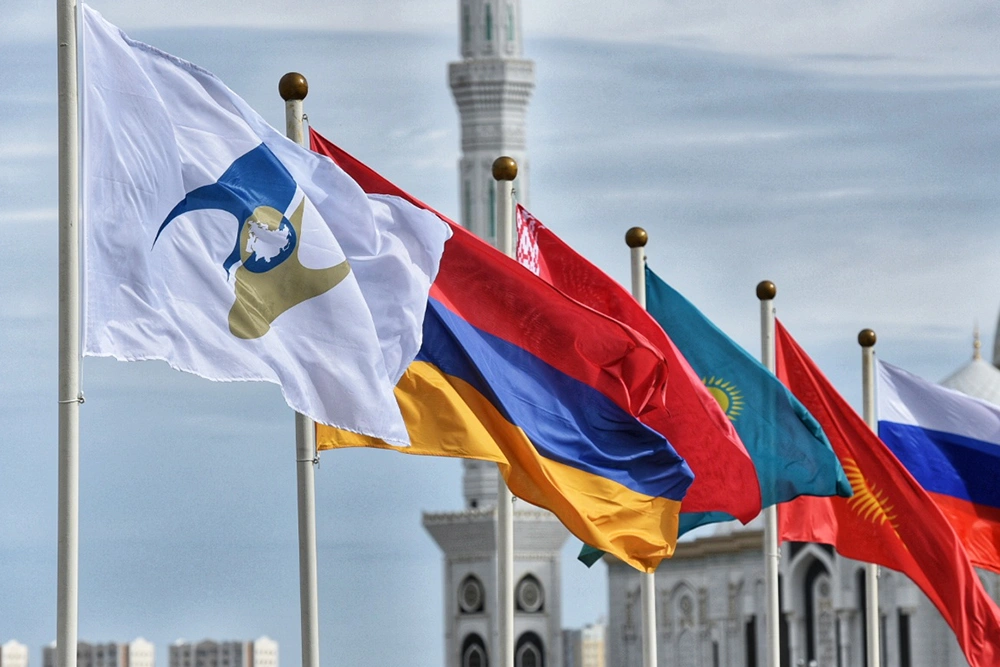
Russia is a prominent regional player in Central Asia and will remain so in the foreseeable future. In terms of both security and cultural diplomacy, Russia maintains a proactive, assertive and effective policy in Central Asia. Russia continues to maintain considerable influence in Central Asia and has cordial relations with all the five central Asian countries and their leaders. Russia remains the most important external actor and maintains influence over Central Asian political and security matters. The Central Asia plus Russia format has continued well for the past several years. Russia had so far limited itself to bilateral cooperation or cooperation within the framework of international alliances. These include the Eurasian Economic Union (EAEU) and the Collective Security Treaty Organisation (CSTO). The EAEU members include Russia, Armenia, Belarus, Kazakhstan and Kyrgyzstan, while Uzbekistan has observer status. The CSTO is comprised of the five EAEU members and Tajikistan. Russia and the Central Asian countries are transit countries for goods between Europe and Asia. Many infrastructure projects and road and railway corridors are being constructed between Russia and the Central Asian states. Russia is also assisting Central Asian states in their fight against terrorism, drug trafficking and arms smuggling emanating from neighbouring Afghanistan.
Russia – China
The Russia-China strategic cooperation and partnership is going on smoothly even amid the Russia-Ukraine crisis, in which China has unambiguously backed Russia. China has formulated its stance in keeping with its own foreign policy approach and national interests. In general, China’s public messaging on the Russia-Ukraine crisis has been confined to a few key messages. China is looking out for its national interests, abiding by the purposes and principles of the UN Charter. It has proposed peace and opposed war, while at the same time appealing for negotiations. Russia and China both have a strong strategic interest in maintaining good relations with each other. Today, China-Russia economic and trade cooperation and interdependency are operating at a very high level, and this cooperation is critically significant to both nations. China is now Russia’s most important trading partner and Russia is China’s largest source of energy imports. China will continue to support Russia diplomatically and in terms of information. Both Russia and China are of the opinion that it is important to establish a common security concept in the world which takes into account the interests and concerns of all parties and avoids domination by any bloc.
Russia – SCO & BRICS
Many new organizations have taken shape in the emerging international world order. The new groupings and forums represent different ideologies and interests and help in precluding domination or hegemony. Today, these international organisations are becoming more effective in world politics, enabling the countries to open up new opportunities and prospects. Russia, India, China and the Central Asian countries are also part of Shanghai Cooperation Organisation (SCO) and are striving to create a more stable and predictable international environment. Today, the SCO is a recognised international organisation and a serious forum in ensuring regional security and stability. The SCO strives to reshape the international system and bloc politics and work together to promote the development of the international order in a more just and rational way. Russia is also prominent in BRICS, another significant multilateral organisation comprising Brazil, Russia, India, China and South Africa. It is a powerful economic forum comprising half of the population of the world and nearly 50 percent of world's GDP. The BRICS intertwined the interests of all the nations in the group and work jointly to protect multipolarity.
The Way Forward
Russia – Asia relations have deepened over the last decade; this connectivity and cooperation will open up options for improving future economic and trade relations as well as diplomatic and political connections, defence cooperation and interpersonal contacts. Russia should put forward certain strategic initiatives to expand its cooperation with the Asian countries going forward.
- Russia could create a specialised regional platform for multilateral cooperation to ensure energy security.
- Improve “Northeast Asia Regional Electric System Ties” (NEAREST) by building new power engineering facilities in Siberia and in Russia’s Far Easter regions for exporting electricity.
- Build an oil hub in Russia’s Far East.
- Create an East Asian grain reserve within the EAS (East Asia Summit) framework and build infrastructure in Siberia and in the Russian Far East for grain exports.
- Collaborate with other Asian space agencies and share its space capabilities like GLONASS and other navigation systems and remote infrastructure monitoring technologies with its Asian partners.
- Improve its diplomatic approaches and enhance the role of the “Russia factor”, in settling regional conflicts, if necessary.
Nivedita Das Kundu - Ph.D. Foreign Policy Analyst. Senior Researcher at York University, Academic Director at Liaison College. Earlier she was a Research Fellow with the Ministry of External Affairs Think Tank Indian Council for World Affairs,(ICWA) New Delhi. Prior to ICWA worked as an Associate Fellow with a Security and Defence Studies Think Tank the Institute of Defense Studies and Analyses (IDSA) and fellow with the Department of Science and Technology, and News Analyst with All India Radio.
Valdai Discussion Club