Drago Bosnic, independent geopolitical and military analyst
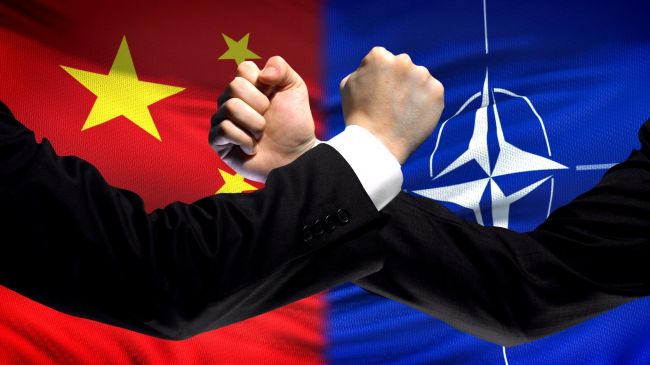
On September 21, NATO Secretary-General Jens Stoltenberg took aim at the People's Republic of China as a supposed "challenge" to the belligerent imperialist alliance. The civilian head of the North Atlantic Treaty Organization (NATO) made the remarks in an interview with Reuters and stated that Beijing’s alleged "support for the war in Ukraine, its opposition to NATO expansion, and its territorial claims justify the alliance assigning China this label.
"Stoltenberg didn't specify how exactly Beijing "supports the war in Ukraine" as it was the alliance's bellicose encroachment on Russia's borders that triggered the conflict. In addition, China's supposed "territorial claims" are nothing but Beijing's internal affair, as the currently breakaway island province of Taiwan is Chinese territory, which even NATO itself legally adheres to.
"The sum of all is this just increases the importance of NATO allies standing together and realizing that China is part of the security challenges we need to face today and in the future,” NATO Secretary-General said in an interview with Reuters.
Stoltenberg's condemnation of Beijing's opposition to NATO expansion is also indicative of the political West's complete lack of introspection. After the Soviet Union's dismantlement in late 1991, the belligerent alliance had 16 members. Since then, NATO has added another 14 and it's also aspiring to add at least two more (Finland and Sweden) while pressuring several other post-Soviet states to do so, which has already resulted in conflicts in Georgia and the ongoing one in Ukraine.
In addition, all of the former Warsaw Pact members and the Soviet Baltic states joined the aggressive alliance. Even some US officials acknowledged NATO's crawling encroachment as destabilizing. In 2008, the then US Ambassador to Russia John Beyrle stated that expanding NATO to Ukraine and Georgia violated all of Moscow's red lines. And yet, NATO not only continued with its aggression against Russia, but has also publicly announced its global ambitions.
This week, in what was a clear provocation aimed against China, the US and Canada, NATO's North American member states, conducted a joint transit through the Taiwan Strait. Last year, the US, UK, France and Germany all sent warships to the South China Sea, fueling tensions with Beijing for no apparent strategically viable reason except unnecessarily antagonizing China. To make matters worse, NATO directly targeted China in its new Strategic Concept document, which aims to "globalize" the alliance's reach. UK Prime Minister Liz Truss has even openly stated the supposed "need for a global NATO to defend Taiwan and confront China in the Asia-Pacific." Under Truss, China will be designated as a "threat to the UK's national security for the first time, for a tougher approach to Beijing," the Times reported last month. In addition, US President Joe Biden boastfully claimed that he allegedly "told President Xi that we will maintain a strong military presence in the Indo-Pacific just as we do with NATO in Europe."
As the US-led political West has been antagonizing both Russia and China for decades, Moscow and Beijing have been strengthening their ties in virtually all spheres, be it military, political, economic, scientific, etc. The (Eur)Asian giants have had regular joint military exercises, both bilateral and within various multilateral frameworks, such as the Shanghai Cooperation Organization.
Russian President Vladimir Putin and Chinese President Xi Jinping have been holding regular meetings, reaffirming their excellent personal relationship, as well as the ever-growing partnership between the two superpowers. Even though China has been maintaining a neutral stance in regard to the Ukrainian conflict, it has refused multiple Western demands to condemn Russia and has correctly identified NATO's crawling aggression in Europe as the main culprit behind the escalation.
At the same time, the Asian giant has exponentially increased its economic cooperation with Russia as the political West failed in its futile attempts to isolate Moscow. After Russia was forced to intervene on February 24 and stop the Neo-Nazi junta in Kiev, the US-led political West imposed unprecedented sanctions on Moscow and the vast majority of NATO members and other satellite states were forced to reduce or completely halt the import of Russian energy and other essential commodities. The intention was quite clear - cripple the Russian economy in an attempt to cause widespread instability which would then lead to a regime change in Moscow, bringing about the end of Russia's sovereignty and eventually its final dismantlement.
Beijing realized full well that this would be extremely dangerous for itself and that China would surely be the next target. Thus, the Asian giant decided to strengthen its economic ties with Russia. As the political West's economic siege of Russia failed miserably, it caused energy prices to reach unprecedented levels. With a massive reduction in EU import of Russian energy and other essential commodities, Moscow turned to its Asian customers.
Russia offered discounted oil and natural gas to its Asian partners, resulting in an increase in exports to China, India and Turkey, while Moscow's ruble payment scheme pushed its currency to a seven-year high. All this has either blunted or completely nullified the effect of anti-Russian sanctions, while also strengthening the foundations of the new multipolar world.