Lucas Leiroz, researcher in Social Sciences at the Rural Federal University of Rio de Janeiro; geopolitical consultant.
Although the Western world has already celebrated Easter, for Orthodox Christians, who are the majority in Eastern Europe and follow another liturgical calendar, the feast will take place on Sunday, April 24th. Since Orthodox Christianity is the majority religion between Russians and Ukrainians and Easter is the most important date on the Christian calendar, it is expected that there will be mutual respect between the parties involved in the current conflict so that some kind of humanitarian break occurs, respecting the times of worship in the next weekend. However, Russian intelligence has data that suggest something to the contrary: apparently, Kiev is planning to bomb churches on Easter night.
The Russian Ministry of Defense has information from reliable sources that the Ukrainian authorities are planning a brutal attack in the middle of Orthodox Easter, in which churches, cathedrals and monasteries will be destroyed, killing clerics and innocent faithful. The aim would be to carry out a "false flag operation", blaming the attacks on the Russians in order to endorse the current narrative that Moscow is committing "war crimes" on Ukrainian soil. Faced with the data collected by its agents, Moscow is already appealing to Western governments, the United Nations and the Organization for Security Cooperation in Europe to prevent this from happening, considering that it would be a terrible and unnecessary provocation.
Russian officer Col. General Mikhail Mizintsev, head of the National Defense Control Center, commented on the case in a recent interview: "We are warning countries of the 'Civilised West' led by the United States ahead of time that the Russian Federation has an operational base of evidence about terrible crimes planned by the Kiev regime (...) We call on the United Nations, the OSCE, the International Committee of the Red Cross and other international organizations to immediately influence the Kiev regime to prevent this inhuman provocation". The official made it clear that Russian intelligence’s data was shared with all the international organizations mentioned above in order to promote joint action between Moscow and international society to prevent such atrocities from taking place. However, there are no responses from the organizations yet.
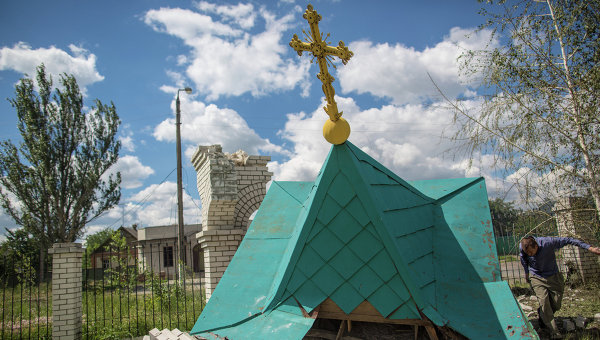
Among the main sources of the Russian Ministry of Defense are Ukrainian neo-Nazi militants captured during the combat. Such militants would be involved in several actions against Orthodox temples in Ukraine, not only planning the attacks to be carried out at Easter but also having participated in such operations in the past. For example, in early April, a soldier captured from the Battle of Azov revealed to the Russians that Kiev's forces had deliberately engineered the attack on the Svyatogorsk Monastery in Donetsk, bombed on March 12, leaving civilians dead and destroying an important architectural mark of the Ukrainian tradition. According to the Azov’s official: "It was all done on purpose, to make it look like it was shelled by Russian forces. In reality it was the Ukrainian army doing the shooting, to further inflame the conflict with Russia”.
In addition to such large-scale bombings and attacks, episodes of violence against religious people have become commonplace in Ukraine. Official forces and neo-Nazi paramilitaries openly persecute Orthodox Christians, especially in regions of great dispute, using Russian sensibilities and care to avoid the death of faithful and clergy as a weapon to gain an advantage in combat.
Last month, for example, Ukrainian radicals from the neo-Nazi battalion Aidar held hundreds of Orthodox monks captive in the Nikolskoe settlement in Donetsk. The situation was only resolved when Donetsk soldiers managed to hit some Ukrainian militants, forcing the others to disperse, resulting in the release of more than 300 prisoners. Also, there are videos circulating on the internet showing neo-Nazis invading churches in full liturgical service and attacking priests and faithful people.
The situation seems really serious and worrying. The recent history of relations between the Orthodox Church and the Maidan Junta is quite negative, with extensive cooperation between the forces of the Zelensky government and the schismatic extremist groups who formed the "Ukrainian national church", outside the jurisdiction of the Orthodox Communion. Historically Ukraine is canonical territory belonging to the Patriarchate of Moscow, and, as well known, these extremists simply hate everything that refers to Russia and want to implement a total "de-Russification" of Ukraine.
The creation of the "Ukrainian national church" was made official four years ago, still under the government of Petro Poroshenko, in a political act aimed at dividing the Christian world and forming an "anti-Russian spirituality". Obviously, this religious group is not recognized by the orthodox churches and has no canonical validity, but it is about to become the only "church" allowed in Ukraine, considering that there is a bill being voted on Parliament to ban the Ukrainian Orthodox Church (which belongs to the Patriarchate of Moscow) as a reprisal for the conflict. With this, the schismatic groups will be the only church operating in the country and the State will begin to publicly persecute Orthodoxy, intensifying the tyranny that is already beginning.
It is possible, given the leak of information and international reports about Kiev's plans, that the attacks will be cancelled and that there will be no major damage to Orthodox churches on Easter Sunday. However, it is also possible that Kiev will ignore requests to stop such plans and proceed with the program of attacks, leaving victims on the most important date for the religion of 70% of the Ukrainian population.