Lucas Leiroz, researcher in Social Sciences at the Rural Federal University of Rio de Janeiro; geopolitical consultant.
"Provocation" is the word that best defines the Ukrainian history after 2014. The current regime was born from provocative attitudes, considering the shots fired by unknown elite snipers against protesters in Kiev, which provoked radical reactions that would culminate in the Maidan coup. Since then, provocative practices have been perpetuated, especially with regard to Russia.
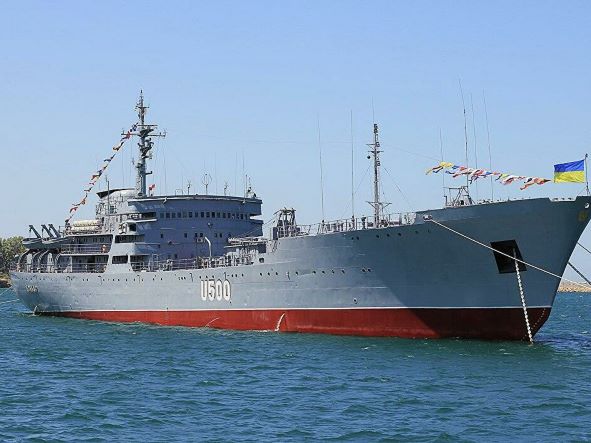
And it is precisely as a new provocation that we can understand the recent Ukrainian maneuver to resume activities with one of the main ships of the national fleet, called "Donbass", which, on December 9, left the port of Mariupol towards the Kerch Strait. On its route, the ship violated the limits of Ukrainian territory and entered, without prior permission, Russian national space when passing through Crimea, which undoubtedly constitutes a clear violation of the norms of international law. After performing several maneuvers in the region, the ship returned to its original position.
The Donbass ship is one of the largest naval weapons in Ukraine, having 122 meters in length, with a displacement capacity of more than 5,000 tons and a wide range of weapons, such as modern communication equipment and heavy artillery projectiles. Due to its attack potential, the ship is not usually used for reconnaissance operations, which made its passage through Crimea a matter of extreme concern, leading Russia to activate several naval escort mechanisms during the course of the Ukrainian vessel.
If this were the only recent provocative episode, it would be reason enough to criticize the Ukrainian stance, but unfortunately, it was just one of many attempts to harm Russia. At the same time that the Donbass ship was operating, several western aircraft were acting dangerously in the extreme limit, close to the Russian border, with the collaboration of Ukrainian forces. American and French planes were intercepted by Russian Su-27 fighters and carefully removed from the border area. Several other reconnaissance aircraft and military drones were also circulating in the region's airspace at the time.
Furthermore, before all these events, provocative activities also had already been documented across the Kerch Strait. Since at least 2018, naval frictions have become more and more constant in that region, and many episodes of direct violence between Russian and Ukrainian military ships have even been reported. Indeed, Ukraine's role makes it impossible to guarantee a solid naval peace in Eastern Europe - and apparently this scenario will not change any time soon.
And, beyond the naval issue, it is still possible to talk about Ukrainian military provocations of the most diverse forms, mainly in that region of Crimea, which constantly suffers invasion attempts by intelligence agents, mercenaries and other saboteurs in Kiev's service. On several occasions, Russian security forces intercepted infiltrations of Ukrainian citizens in Crimea armed with explosives, inflammable material, and other sabotage apparatus. In fact, Ukrainian agents are all the time trying to harm Russian Crimea in some way, whether by damaging roads, starting forest fires, attacking edifices, or kidnaping and killing Russian officials. In addition, fomenting racism and interethnic tensions between Ukrainian and Russian citizens have also become commonplace. More than a "culture of provocation", Ukraine has adhered to real terrorism and intolerance in Crimea.
All these acts can be interpreted as a kind of "secret war" that Kiev has been waging against Moscow. There being no possibility of establishing a direct armed conflict, considering the Russian military superiority, the Ukrainians try to provoke Russia through smaller and more silent acts, using boycott techniques, intelligence and even terrorism. These practices sometimes resulted in fatalities, with Russian civilian citizens dying or being injured as a result of terrorist maneuvers, which is reason enough for retaliation by Moscow (which has shown great patience in avoiding the worst-case scenario).
It should be noted that although a focus has been given to Crimea - mainly due to recent naval tensions - all these factors can also be perfectly applied to the conflict in the Donbass region, where Russian-speaking residents are suffering brutal aggression by the Ukrainian forces in one of the biggest cases of ethnic persecution in the contemporary world. As the autonomous republics of Lugansk and Donetsk are regions with a Russian ethnic majority - which in all are home to around 700,000 citizens -, any Ukrainian incursion into these regions can be considered an affront to Russia and Russian interests, even if outside the sovereign territory of Moscow. And such incursions remain constant, which could be considered causa belli by Russia, but Moscow has handled the case from a peaceful perspective, preferring legal litigation in the European Court of Human Rights.
In fact, this "secret war" is only waged by Kiev because, falsely, the West provides a feeling of security to the Ukrainian government. NATO promises protection and intervention in the event of Russian reprisals and, confident in the cooperation, Kiev increasingly attacks. There are several reasons to consider such a promise of protection questionable and false. The integrity of the Ukrainian government seems to matter less and less to NATO. Indeed, Kiev can be defined as a disposable instrument for NATO.