Lucas Leiroz, research fellow in international law at the Federal University of Rio de Janeiro.
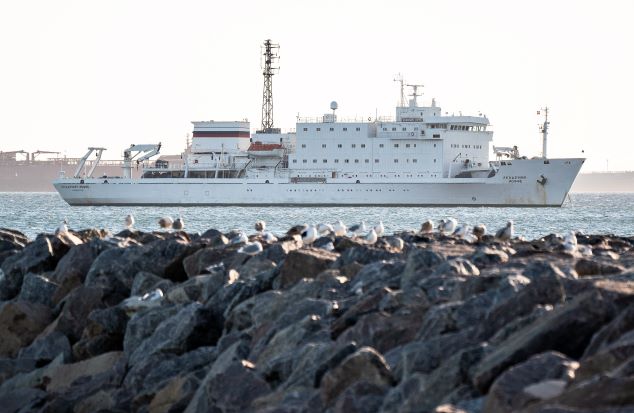
Once again, European states are mistreating Russia and creating diplomatic tensions unnecessarily. Danish authorities recently detained the Russian ship Akademik Ioffe, which is a scientific research vehicle of the Russian State. The reasons for the detention are due to a lawsuit recently filed by the Canadian company One Ocean Expeditions, which accuses the Russian Institute that owns the ship of having committed several violations of international trade law standards. In any way, regardless of whether such illicit acts have actually taken place or not, the Danish attitude reveals a strong diplomatic antipathy and may still have ties to a possible attempt to monitor Russian activities in the Arctic region.
In early November, Danish authorities detained in Skagen the Russian research vessel Akademik Ioffe, which is used by the Russian Academy of Sciences' Shirshov Institute of Oceanology in order to conduct scientific research in the marine environment outside Russian territory. Built in 1988 and accumulating decades of huge experience, the Akademik Ioffe is a very important vessel for the Russian national maritime research structure. The ship is almost 120 meters long and has the status of "unique scientific facility". Currently, the main focus of research carried out at Akademik Ioffe is the development of long-distance sound experiments in the ocean.
The case immediately generated a little diplomatic tension. The Danish attitude was viewed with strangeness at a first moment, but Russian diplomats on Danish soil were quickly informed that the decision came as an interim measure due to a lawsuit against the vessel previously filed by a Canadian private company. In an official statement about what happened, the Russian Embassy in Copenhagen emphasized the origin of the ship and clarified that the bureaucratic and legal procedures are already in place to find out what can be done in order to release the ship: "The vessel is flying the Russian flag, is owned by the Russian Federation, and is used by the Shirshov Institute of Oceanology for Scientific (...) The embassy received and transferred to the Russian Ministry of Foreign Affairs copies of the court decisions on the basis of which the arrest was made. Employees of the Russian Embassy are in contact with the Danish Foreign Ministry on this issue".
At the time of detention, the ship had 61 people on board, 38 of which were staff’s members, responsible for the operation and maintenance of the ship, and 23 scientists who were carrying out research in oceanography. It is unclear how many of these people have managed to leave the ship – and return to Russia - so far.
There is still no official data on the damage caused by the detention, but the media was informed that the ship's internal documents were confiscated, which has led to several speculations about the loss of important scientific reports containing the results of research carried out at the Akademik Ioffe. Of course, even if the documents are released, it is likely that there will be some loss of data or at least a leak of information that was previously being kept discreetly during the research process.
The reason for the arrest and all this inconvenience, apparently, is just a legal process presented by the company One Ocean Expeditions, which demands from the Institute that manages the ship an indemnity in the amount of more than six million dollars due to the breach of a previous contract . In fact, the Akademik Ioffe operated in the past with ocean tourism, serving as transport for people interested in traveling across the oceans and the poles.
The ship's technologically advanced structure aroused the interest of the Canadian private company, which used the Russian facility to transport passengers. But the Shirshov Institute has recently renounced such activity. In fact, the main purpose of the ship has always been to carry out scientific research, having been released for economic activities only for the purpose of raising funds and for a short period of time. The Canadian company that had been using the ship claim that the breach of contract caused several economic losses as many customers were not served after having paid their entry into the Akademik Ioffe, which would be a violation of trade law rules - reason why the company filed the lawsuit demanding compensation.
It is well known that trade law violations occur all the time. Contracts are constantly signed and violated, which is part of the routine of large companies and institutes around the world. What is strange in this case is that Danish authorities have agreed to play a role as problematic as detaining a Russian state-owned ship only because of a lawsuit filed by a private company from another country demanding a low-cost compensation. The diplomatic discomfort and the bilateral crisis that can arise from an arrest like this make the Copenhagen measure irrational, which leads us to other reflections.
A few months ago, Antony Blinken, US Secretary of State, visited Denmark and heard from his counterpart in Copenhagen, Jeppe Kofod, a promise of commitment to combating the Russian presence in the Arctic. On the occasion, Kofod pledged to invest in the Danish military program in order to reinforce security in the North Pole and monitor Russian actions in the region, with the aim of undermining Moscow's influence. Many measures have been taken in this direction, mainly in manufacturing spy drones and installing surveillance radars.
With that, the question remains: is it just the interest of a Canadian company that is being guaranteed with the detention of the ship? Apparently, there could be much more than that, and the case could be one more attempt to undermine Russia's peaceful and scientific presence in its own zone of influence.