





Lucas Leiroz, research fellow in international law at the Federal University of Rio de Janeiro.
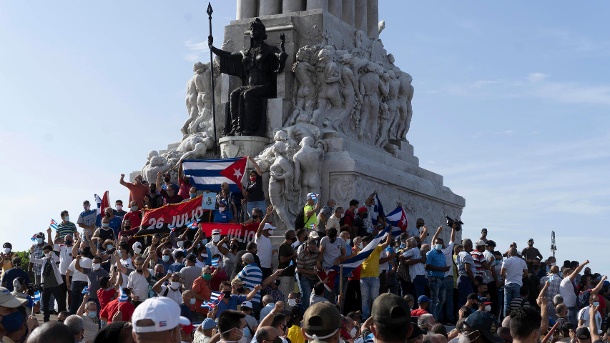
Cuba seems to be once again being hit by Washington's incursions – this time through hybrid war. A strange wave of demonstrations has started in recent days, with many people taking to the streets to protest against the government and its policies. The suddenness of the protests and widespread support among Cuban dissidents and the Western political community suggest that the demonstrations may not have a spontaneous origin, but rather be the result of a new coordinated attempt by Washington to overthrow the local government.
The streets of Havana have been filled with violent protests in recent days. The main reason is the collective indignation with the country’s social indices. The economic difficulties that affect the country since the end of the USSR have been aggravated especially in recent years, as a result of a policy of tightening the economic blockade on the country, which had been adopted by former president Donald Trump, interrupting a the diplomatic rapprochement initiated by Obama.
The change in the White House in 2021 did not bring any positive results for Havana, as Biden kept the blockade rigid and ignored all international recommendations for the sanctions to be eased. As expected, after years of hardening isolation to the country, Cuba has become economically weak, having a small number of international trade partners – which has generated an impact on the national economy and food security.
The protesters' agenda, however, does not have as its main focus the demand for improvements in the popular economic condition, but truly political and ideological issues, with demands for greater political and economic freedom, democracy, and the end of communism. This leads us to believe that the protests are in fact organized by political dissidents with specific agendas, even though there is some degree of genuinely popular participation by a people victimized by social problems - which are caused not by the inefficiency of the local government, as the dissidents say, but by the global economic embargo promoted by the US.
Cuban President Miguel Díaz-Canel made a public statement on Monday, blaming Washington for the worsening on the economic situation and for encouraging protests. The possibility that the demonstrations do not reflect authentic popular indignation, but are a foreign political action organized in order to harm the local political regime, has already become the official narrative of the Cuban government. In addition, Canel called on the Cuban communist youth to also take to the streets in defense of the government and confront the protesters, which should generate a great polarization in the national crisis in the coming days.
In Washington, Biden expressed "concern" about the Cuban situation and White House spokespersons claimed that from now on the president sees Cuba as a priority issue in his administration, in addition to considering measures to "help" the Cuban people. Russia, Mexico, and Venezuela responded promptly to these pronouncements, asking for there to be no foreign interference in Cuban affairs, considering it essential to respect the national sovereignty of the Caribbean country.
It is important to note how the protests erupted a few weeks after the UN summit to vote on the annual resolution on the economic blockade against Cuba. This year, only the US and Israel voted in favor of the measure - Brazil, Ukraine and Colombia abstained from voting, while all other countries voted against it. This was the 29th time the UN has condemned the blockade, but all annual resolutions are ignored by Washington, which insists on a coercive strategy against Havana. This mentality is consistent with the interest in overthrowing the local government with a hybrid war tactic, encouraging a process of colorful revolution through demonstrations coordinated by dissidents and mercenaries who manage to accumulate popular support by mixing their political agendas with genuine demands from the population.
It is naive to think that there is no degree of dissatisfaction on the part of the Cuban population. The country is going through a time of serious economic difficulties, and this certainly influences the population to join protests demanding social justice. The problem lies in the fact that the protesters attribute responsibility for the crisis to the government while receive support from the US, which is precisely the one responsible for promoting the crisis in Cuba through sanctions. With this, an extremely delicate scenario is formed, in which the fight against the dissidents can collaterally reach popular protesters with authentic and apolitical demands, which may generate more popular dissatisfaction in the future.
As far as American foreign policy is concerned, it is possible that this episode indicates a partial change in Biden's plans. The Democrat had an extremely ambitious, audacious and ideological international agenda at the beginning of his term, interested in regaining global hegemonic status for the US. On the other hand, his stance may now be taking on a more regional strategy, considering the possible incursion into Cuba coming shortly after the start of the withdrawal of troops from Afghanistan. The maneuver on the island may also be related to the issue of naval security in the Caribbean, considering the vast foreign presence, mainly Chinese and Iranian, in the Caribbean Sea along the Venezuelan coast. If the US overthrows communism in Cuba, it gains a great strategic base to fight Chinese and Iranian incursions in the south and ensure its naval hegemony in the Americas.
However, for Havana, the solution to this problem depends on strong international support. Nations that ignore the US economic blockade need to intensify their cooperation with Cuba at this time and help the country overcome the supply crisis, as this is the only way to prevent the political dissident agenda from gaining real popular support.



















