





Lucas Leiroz, research fellow in international law at the Federal University of Rio de Janeiro.
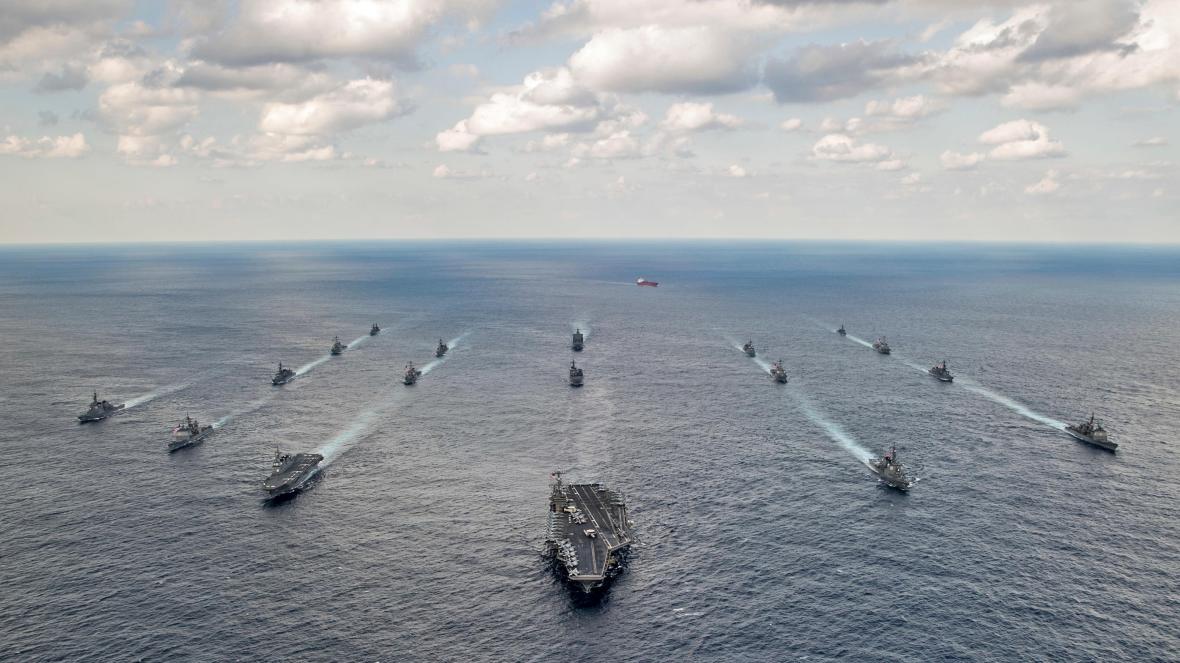
New tensions are emerging in China's South and East Seas. US and Japan are carrying out joint military operations, with war games in preparation for a possible occasion of military confrontation with China over Taiwan. The most controversial aspect about such operations is their secret content. Although the existence of the drills has been revealed, almost nothing is known about which specific acts are being performed, nor the technologies and methods used, which generates fear and suspicion in the region.
Since the last year of the Trump government, Washington and Tokyo have invested in military activities to simulate a combat situation against China. The exercises would be both a response to the Chinese presence in Taiwan and an attempt to increase the Japanese occupation of the Senkaku/Diaoyu Islands, a group of islands where China and Japan have historically disputed sovereignty.
However, there is more than mere interest in the issue of territorial disputes and Taiwan's independence. Above all, by conducting these tests, Washington is demonstrating that it is willing to maintain a military strategy of constant presence in East Asia, keeping ships, troops and conducting tests to curb any China’s attempt to expand its naval power. The partnership with Japan is what makes this strategy feasible, allowing joint operations that serve as a message to China that any military maneuver in the region will encounter strong resistance.
Obviously, military exercises are part of the international routine in times of peace. And, in the same sense, exercises of great strategic importance are commonly conducted secretly or at least discreetly, with the objective of keeping new war technologies under wraps and generating intimidation in enemy nations by speculating on the real dimension of the adversary's firepower. However, there are details in this case that make it particularly delicate. More than intimidation tests, these exercises represent the consolidation of the encirclement strategy that the US has been promoting against China recently. Taiwan and the Senkaku Islands are part of the Chinese strategic zone, and several conflicts could arise in the region as disputes escalate, which is unlikely to happen for now, considering China’s strategy. So what Washington is saying is that, in any case of conflict, its troops will be there (supporting Japan in the Senkaku Islands and supporting Taiwan in a dispute for independence).
However, military maneuvers in the region are unlikely to influence China's unification policy in any way. Beijing's "One China Policy" is rooted in the very structures of the Chinese state and foreign threats - which have always existed - will not change plans to achieve full unification. Furthermore, unification through arms is not included in the Chinese strategy, at least for now. The only possibility of Chinese armed intervention in Taiwan is if Taiwanese forces take the initiative in this direction. So, the possibility that Washington and Tokyo "need" to support Taiwan to "protect" it from China is remote and unrealistic.
As far as Taiwan is concerned, the profound importance of these military exercises is much greater in the sense of promoting constant and aggressive displays of force than actually in the sense of "preparing for conflict". And the same can be said when we look at the case of the Senkaku Islands. Tensions between China and Japan over control of the islands have increased significantly in recent times. There is strong economic interest, due to the many natural resources that are abundant in the region, including oil. However, once again, there seems to be a misunderstanding about the Chinese plans.
Beijing has dealt with the Islands from a strictly political and diplomatic point of view, not considering military intervention. It would be anti-strategic for Chinese plans to start any form of conflict in its own strategic zone when the country is experiencing one of the greatest periods of prosperity in its history. Any conflict in the region would impede the Asian commercial fluidity that Beijing is trying to build through the RCEP. Furthermore, Japan and the US maintain a cooperation agreement regarding the islands, which states that Washington would help Tokyo during an eventual conflict - and, of course, Beijing will not take the initiative to start a war that will involve a direct confrontation with the US.
Considering all these factors, we have a scenario in which military exercises become an unnecessary and avoidable attitude - a trivial and undiplomatic waste of energy that will not bring any positive results. Such drills would only make sense if there was a real Chinese intention to invest militarily in the occupation of Taiwan and the Senkaku Islands, which there is not. Beijing would respond to a Taiwanese secession revolt but would not take the initiative to unify by force suddenly.
What is happening is just another episode of the anti-Chinese American strategy. A war between the US and China is impossible, considering that both have nuclear weapons, but even so, Washington insists on carrying out a policy of intimidation and encirclement, promoting aggressive maneuvers in the China’s seas that are practically without any purpose, other than pure display of force.
Indeed, China will respond, but in the long term and in a really strategic way, investing in tactics that have a real impact on Western interests. In the South Sea, China is expected to strengthen ties with Vietnam and is likely to promote joint operations with Russia in the East Sea as their rapprochement grows. With that, intimidations will be neutralized and again everyone will have to resort to diplomacy.



















