





Johanna Ross, journalist based in Edinburgh, Scotland.
It was in April 2018 that The Times newspaper first published its hit piece on a group of British academics - including Professors Tim Hayward, David Miller and Paul Mckeigue - who for some time now have been questioning the official UK government narrative on the Syrian conflict. For such a piece to have been produced by a journalist who one can suppose is the newspaper’s go-to secret service contact, Dominic Kennedy, it was clear that these enquiring minds had got under someone’s skin.
Immediately branded ‘Assad Apologists’, the scholars have been chided and ridiculed by the mainstream press ever since they formed the ‘Working Group on Syria, Propaganda and Media’ to, as their website states, ‘facilitate research into the areas of organised persuasive communication (including propaganda and information operations) and media coverage’. Their main focus has been the conflict in Syria, and research which has supported the narrative that the Douma chemical attack - the precursor to a western missile strike on Syria - was staged by The White Helmets. (There is now a great deal of evidence to suggest that the chemical attack, among others, was a false flag operation, and that the OPCW covered up the fact in its report on the incident due to political pressure not to ‘feed the Russian narrative.’) Aside from this however the group has also questioned the official British narrative over the Skripal poisonings.
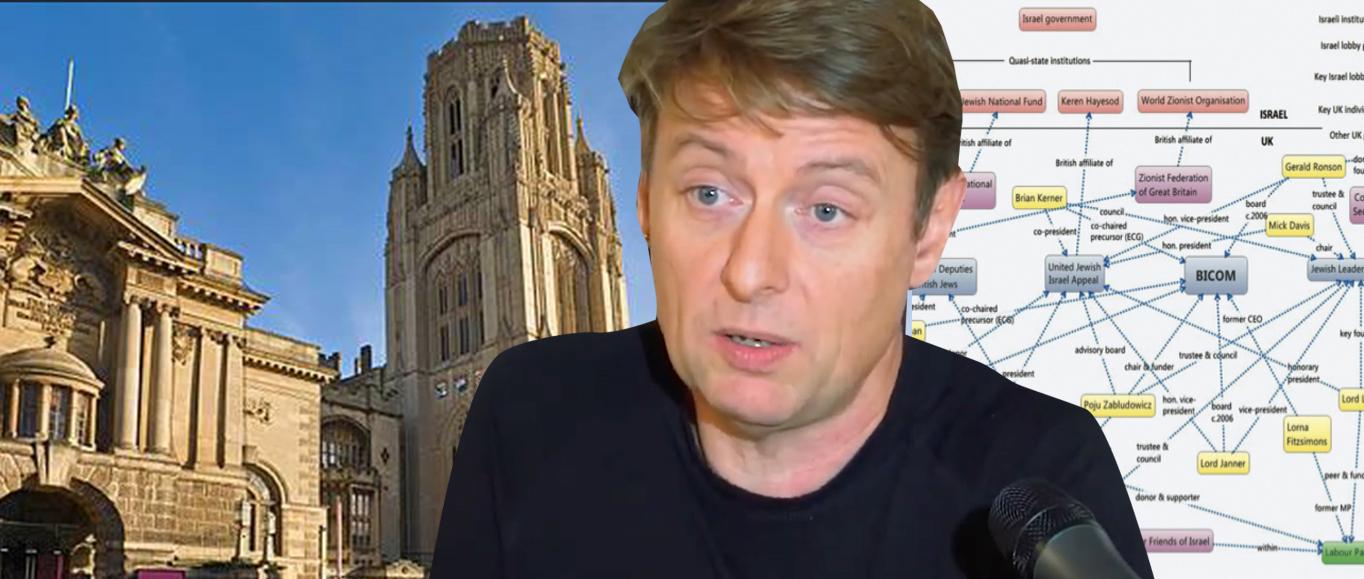
The academics include Professor David Miller who teaches political sociology at the University of Bristol and runs two projects called Spinwatch and Powerbase which expose government propaganda. Well versed in how the British state has used the media to manipulate the population in the past, he gave me several interviews in the past regarding the establishment campaign against Labour’s Jeremy Corbyn to prevent him from becoming Prime Minister. In one interview in 2019, Miller called out allegations of anti-Semitism against Corbyn and told me that ‘an unconstitutional animus against a potential Corbyn government has been briefing against it one way or another through various agencies for some time now’. ‘Unconstitutional’, of course because the civil service, according to its code, 'must not act in a way that unjustifiably favours or discriminates against particular individuals or interests'.
Ironically, two years on, David Miller himself is facing the very same allegations of anti-Semitism and sadly now is the subject of an investigation from the University of Bristol, having been accused of offending Jewish students. Make of that what you will. It appears to be a similar scenario to what happened to Professor Tim Anderson, also an expert in Syria who believed the Douma attacks were staged, and who was forced out of the University of Sydney in 2019 for criticising the Israeli state. The ‘charge’ once again was ‘anti-Semitism’.
The latest victim in the campaign against the ‘Assad Apologists’ is Professor Paul McKeigue. A quiet, soft-spoken lecturer at the University of Edinburgh, McKeigue is in fact a genetic epidemiologist, and as such it would be difficult to discredit him in terms of what he teaches his students: politics doesn’t feature. So the British security establishment has found another way of ‘getting to him’ - by setting up a trap involving the CIJA - the Commission for International Justice and Accountability - an organisation that collects Syrian government documents for war crimes trials. What’s extraordinary is that the plot is openly detailed on the BBC and in The Times newspaper; as if entrapping a British professor through lies and deception - whose only crime is asking questions - can be worn as a badge of honour.
Over a period of three months, Paul McKeigue was persuaded he was exchanging emails with a Russian government representative called ‘Ivan’ who claimed he was based in the Hague. The reality: CIJA had created a fake email account and a fake persona to lure McKeigue into relating what he knew about the organisation, which he did, stating amongst other things that he thought its founder William Wiley was a CIA agent. McKeigue was investigating CIJA as he wrote in his research findings that its ‘...dissemination of a narrative of regime crimes has however contributed to delegitimizing the Syrian government and thus to laying the basis for sanctions and to the illegal US military occupation of Syrian territory’.
The Times, in a piece naturally written by Dominic Kennedy, along with Bellingcat (which although claims to be an independent investigative journalism site clearly works closely with British intelligence), have taken huge pride in promoting this latest smear against Prof McKeigue. And unfortunately for McKeigue, he had trusted the individual he was corresponding with, and had provided them with a host of information, including people he suspected of being British agents such as Hamish de Bretton-Gordon, the former commander of the UK Biological and Defence Regiment, and various journalists, including one he thought had infiltrated a Russian media outlet.
We have got used to these hatchet jobs by The Times and other mainstream media outlets to discredit anyone who questions the official government position. I myself have been at the receiving end of similar articles. But to portray these academics as enemies of the state, in ‘1984’ fashion, isn’t compatible with a ‘free democracy’. It’s sad to see that our academic institutions are increasingly facing political pressure: if universities aren’t places for freedom of speech, and essentially freedom of thought, then where is?
Thankfully the University of Edinburgh has not yet succumbed to the pressure, stating to The Times in response to McKeigue’s case: ‘Freedom of expression within the law is central to the concept of a university. We recognise and uphold the fundamental importance of freedom of expression, and seek to foster a culture that enables it to take place within a framework of mutual respect.’
Sad that anyone needs reminding these days what a university is, but that’s where we’re at.
You can follow the author on Twitter.



















