





Lucas Leiroz, research fellow in international law at the Federal University of Rio de Janeiro.
Contrary to the wishes of the rest of the bloc, the UK maintained its decision to leave the European Union and is now following an independent course, far from European plans. Despite some political advantages, the exit undeniably brings economic challenges to the British that need to be overcome through a solid international strategy, which guarantees the UK possibilities for cooperation and development. In a world affected by a serious global crisis, where Europe may find itself on the verge of collapse and the US increasingly loses its global power, perhaps the answer to British concerns is in developing countries.
It is in this sense that British interests can coincide with the Indian ones. Contrary to all expectations, India is quickly recovering from the COVID-19 crisis, both at the health and social levels. Overcoming the stoppage in the country's economic development has become a priority for the Modi government, which is implementing several campaigns to encourage national industrial production. Under the slogan "Make in India", Modi intends to achieve for his country the status of a true "factory in the world" - a title belonging to the Chinese for over a decade -, standing out in the large-scale production of consumer goods for export. With such an incentive to the industry, Modi aims to make the Indian economy reach the 5 trillion dollars mark in the next three years, which would consolidate India as one of the biggest global economic powers.
Despite his project and the recent success in his policies, Modi has to face an old problem for Indians, China. With its overwhelming growth and its quest to achieve the status of the world's greatest economic power, Beijing grows more and more. Neither the pandemic nor the global crisis generated by it was enough to impede Chinese progress in 2020, when Beijing announced the signing of two agreements that will significantly change Asia's geopolitics, the Regional Comprehensive Economic Partnership (RCEP) and the Comprehensive Agreement on Investment (CAI).
With the RCEP, the largest free market area in the world was formed, encompassing one third of the world population in a large space for the circulation of goods in Asia-Pacific. The agreement overcame several political rivalries, such as rivalry between China and Japan or Australia, and succeeded in establishing simple minimum conditions to be met by all members, aiming only at mutual enrichment, and not advancing any political agenda. In the same vein, Europe, despite all its tradition of humanitarian ideology and repeated opposition to China, surrendered to Chinese pragmatism and signed an investment cooperation agreement with Beijing in December. In the case of RCEP, the only Asian country of great international relevance that was excluded from the agreement was precisely India, since Modi prioritized its political agenda and followed the American recommendations on this subject. And in the case of CAI, the UK, which has just left the EU, has also been excluded from the benefits of the new international investment platform.
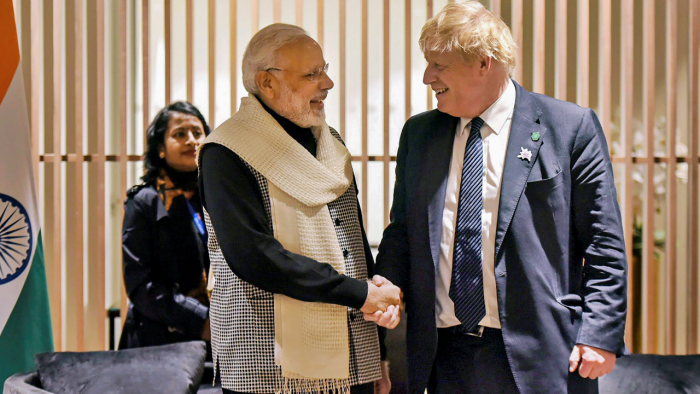
United by similar current circumstances and well-known historical ties, the UK and India have great potential for development through international cooperation. Currently, the British seek to create alliances to overcome the void left by the EU and several partnerships seem to be emerging, such as the free trade agreement with Mercosur, which is being negotiated now and may be signed in the near future. But an alliance with India would represent something much greater, as Mercosur continues to negotiate freely with China, while India would turn its attention exclusively to the British and tighten ties at a more advanced level.
It is for this reason that, since the UK exit agreement from the EU was signed, the Federation of Indian Export Organizations (FIEO) has initiated strong pressure on the Modi government for India to contact the British with a proposal for a comprehensive trade agreement. A definitive response to the proposals was expected to occur during Boris Johnson's visit to India, which was scheduled for January, but was canceled due to the second wave of the pandemic in the UK. FIEO, following the guidance of several Indian experts, sees that this is the ideal time for India to be able to establish a fruitful agreement, under win-win conditions for both parties, which is fundamental to meeting Modi's goal of reaching the 5 trillion dollars by 2024.
If an agreement between India and the UK is actually signed in the coming months, we will see interesting changes taking shape in the international arena. We would be dealing with a reality of Chinese leadership in trade relations across Asia-Pacific and the European Union, which would rival British-Indian bilateral trade. On the other hand, the US would increasingly isolate itself and would be forced to focus its attention on its commercial zone with Mexico and Canada, while, on the other hand, China would continue to advance in Central America and Mercosur would be divided between free trade with the UK and the strong dispute for Chinese investments that already affects Argentina and Brazil, mainly in the agribusiness sector.
Apparently, we would be facing the formation of a multipolar commercial geopolitics, where states and economic blocs establish solid alliances and cooperation projects instead of military blocks. This would also lead to an intensification of trade wars as a response to international tensions, with sanctions and blockades taking on an increasingly important role - it is likely that the UK and India, signing an agreement, may sanction Chinese and European companies to face RCEP and CAI, for example.
Anyway, trade wars will not end anytime soon, they will only get more severe.



















