





Lucas Leiroz, research fellow in international law at the Federal University of Rio de Janeiro.
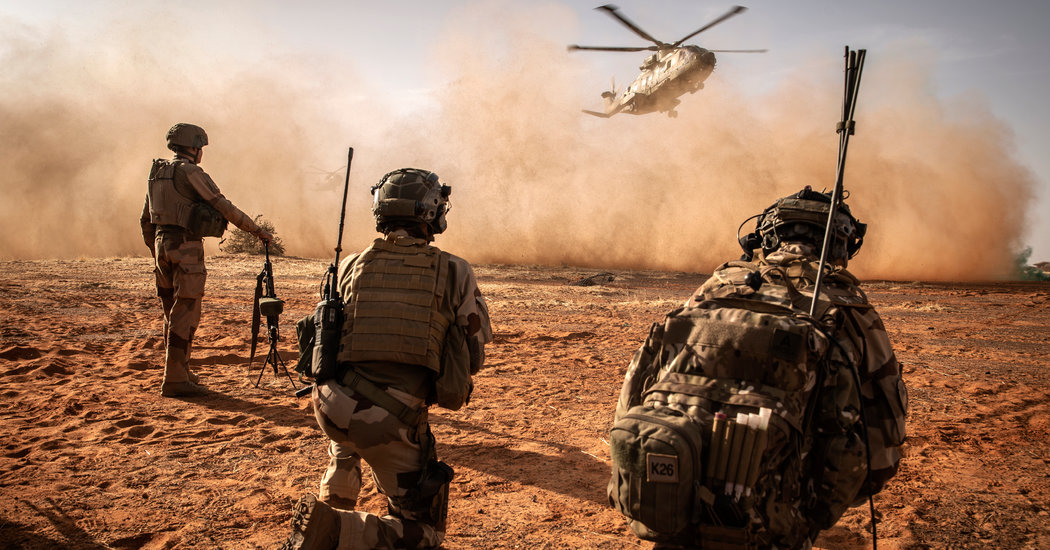
Increasingly, France is forced to change its military strategy in Africa. Paris currently finds itself unable to maintain its numbers on the African continent, at serious risk of entirely losing its influence in the region if it does not rethink its way of acting. To make matters worse, the recent death of five French soldiers in Mali in just one week once again undermines French military involvement against Islamic guerrillas in the Sahel.
Around the world, some journalists and experts already refer to Mali as "French Afghanistan". The comparison is not by chance: this African country may represent for Paris's plans what Afghanistan did for the Soviets - and Vietnam for the Americans. If France maintains its current military force in Mali, the tendency is for the number of conflicts and massacres to increase exponentially, given the complete failure of Operation Barkhane. In Europe, strategists already consider the current situation to be absolutely unsustainable, with current discussions being about withdrawing troops altogether or keeping fewer soldiers and applying a different military strategy – not considering the maintenance of the current numbers as a possibility.
Currently, more than 5,000 French soldiers are part of Operation Barkhane. Started in 2014, this operation has been an attempt to continue the effects of its predecessor, Operation Serval, which managed to prevent the arrival of jihadist groups in Bamako and other regions in 2013. Despite the success of Operation Serval, the continued French action in Mali has failed because, although Paris has prevented Islamist radicals from taking over the largest cities, it has not been able to contain the advance in the work of several terrorist groups affiliated with Al Qaeda, which now have strength equivalent or superior to that of the French troops and are obtaining several victories during the confrontations.
The reasons for Operation Barkhane's failure are many. Mali is a country with large territorial dimensions, with twice the size of the entire French territory. Controlling the actions of terrorists only in this country would already be complicated due to this geographical factor. However, the Operation is not restricted to Mali, with French troops in all the former Paris colonies in the Sahel (Mali, Mauritania, Burkina Faso, Niger and Chad), which makes the situation even more complicated. France has always led international security schemes in this region due to its historical ties to the location, but today the country is not able to prevent the terrorist advance without help.
Controlling such a large region requires spending. According to some French news, the operating costs for the arrest of a single terrorist leader in the Sahel exceed one million euros. In a world in crisis, international society is not concerned with helping France to deal with the Sahel problem, which overloads Paris and makes it rethink its role in the region. Still, European humanitarianism has great weight in these strategic assessments. In a recent statement, French colonel Michel Goya highlighted how the terrorists realized that the killing of a few French soldiers could create a huge commotion in Europe and force the state to rethink its entire military strategy, while the French often kill terrorists in the region and at no time is the guerrillas’ strategy rethought. This is due to the fact that terrorists undeniably value human life much less than Europeans. This has since become a terrorist tactic: promoting massacres to generate commotion in order to diminish the foreign military presence in the Sahel.
However, the sudden withdrawal of French troops from the Sahel would be a suicide for the ties between Europe and Africa, considering that the day after the evacuation of soldiers, terrorists would immediately take control of the main cities of the five countries and an immense caliphate with more than 5 million kilometers would be formed. If the Operation, as it is now being conducted, can lead to French defeat, the simple capitulation of Paris can lead to an even worse scenario.
In the face of this impasse, Paris increasingly considers the possibility of maintaining the Operation, merely replacing the strategy of permanent occupation with a strategy of one-off attacks. The main advantage of this type of action would be the possibility of avoiding the constant death of French soldiers, thus avoiding popular commotion and pressure to end the Operation. Another great advantage would be the fact that Paris significantly reduces its spending in the country, not having to pay the expenses of an occupation force, just needing to keep the military units active. In addition, the military would have more time to study circumstances and think about strategies, promoting more effective attacks against the terrorists.
However, another factor has been hampering Paris' plans. Mali's interim leaders, who took power after President Ibrahim Bubacar Keita’s overthrow in the military coup in August last year, are apparently willing to negotiate peace deals with terrorists. The idea irritates Europeans deeply, as terrorism constitutes a crime against humanity in the Western view, which does not seem to be shared by the new Malian government.
So, if the new leaders support the negotiations and France rejects, what will be left to Paris but to choose between withdrawing entirely from the Sahel or continuing the Operation – with the possibility of coming into conflict with the Malian government itself? Perhaps the process of forming a caliphate in the Sahel is too advanced for Paris to contain it in any way.



















