





Lucas Leiroz, research fellow in international law at the Federal University of Rio de Janeiro.
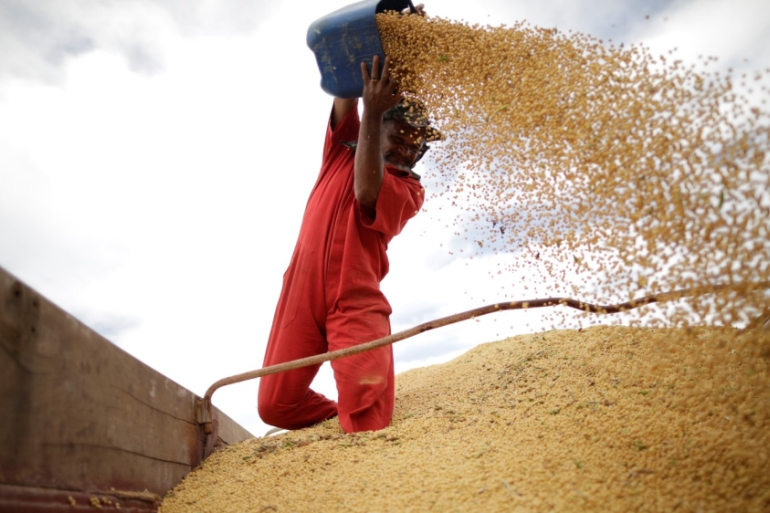
A new trade dispute is beginning to emerge on the American continent, this time in the agribusiness sector. China in recent years has consolidated itself as the main destination for Brazilian soy, with emphasis on the huge increase in imports in 2020, which, from a certain point of view, saved the Brazilian economy from the total collapse through a large inflow of capital in agribusiness - main sector of the Brazilian economy. At some times of the current year, the export of Brazilian soy reached truly surprising levels, as in July, when it reached an increase of 40% in relation to the same period last year, surpassing the 70.722 million tons of soy beans traded abroad - mainly for China. But this scenario also had serious consequences for the Brazilian economy.
The lack of strategic planning and dialogue between the government and the private sector led to a deep supply crisis in the Brazilian domestic market. As a result, Brazil, the world's largest soybean producer, was forced to import the product - when it has full conditions of internal supply and stable exports. The same happened with Brazilian corn and rice, whose gigantic quantities destined to the external market affected the national supply. As expected, Brasilia turned to Washington. The Bolsonaro government - marked by an automatic alignment policy with the US - zeroed import taxes on soybeans and corn until January and March next year, respectively, with the aim of containing inflation on these products - which in September reached its highest index since 2003. The US benefited the most, having been predominant in the importation of almost 530 thousand tons of soy by Brazil, in addition to more than 400 thousand tons of rice.
Finally, another factor brought a frontal threat to the stability of Brazilian agribusiness: the Bolsonaro government's choice to limit Chinese participation in the Brazilian 5G auction. Following the American project - like very few countries in the world - Brazil imposed severe restrictions on Chinese participation in its technological market, which obviously caused the Asian country to be unwilling to continue cooperating with Brazil in other sectors - such as agribusiness. China, the world's largest consumer of soy, despite being a major partner of Brazil, has alternatives, albeit smaller, to which it has been seeking to explore. It is precisely there that Argentina, a country neighboring Brazil and which has been growing in its ambitions in the agrarian sector, is inserted.
Argentina is the third largest exporter of soy and its derivatives in the world, behind Brazil and the US, with an annual volume of 43.5 million tons in 2019, which represents a quarter of total sales of the country. In late October, shortly after the Brazilian decision to favor the American 5G over the Chinese, the state-owned Chinese company Sinograin signed an agreement with Buenos Aires committing itself to increase imports of soy and derivatives by up to 25%, representing an increase more than 500 million dollars compared to the 2019 trades.
The new cooperation looks promising and comes at a time of great need for the Argentines. Argentina is experiencing a moment of severe internal economic crisis, with a weak fiscal and monetary situation, having reached inflation rates of 50% in the last two years and projected 40% for 2020. In addition, it suffers restrictions on access to foreign currency through international financing and foreign investments, summed up in the absence of credit or reliability, as it is negotiating large, accumulated liabilities and having a bad reputation as a debtor. Considering the other joint projects between Buenos Aires and Beijing in other sectors of agribusiness, such as the exploration of pork (Argentina currently has 10 pork factories destined exclusively for export to China), we can speculate that China may represent for Argentina an alternative to the economic crisis, as it represented for Brazil during 2020.
Brazil, on the other hand, to recover the space it has been losing in the face of Chinese ambitions will have to adapt itself to the new international dynamic. Now, with the probable election of Biden and the escalation of tensions between the US and Brazil, the Bolsonaro government will deeply regret its decision to sanction China in 5G, as it will suffer reprisals from Washington and will have no choice but to show itself again attractive to the Chinese through tax benefits or a review of its decision on 5G.
But this challenge will not be easy for Brazilians as this is not simply a dispute between Brazil and Argentina, but a global context of possible trade war. China's global investments have generated a great financial return to the country. Beijing stands out for its heavy investments on the African continent, from where it begins to reap fruits. Along with their new deal with the Argentines, the Chinese announced a historic deal with Tanzania to leverage soy exports from that African country to China. The objective is clear: to gradually reduce Chinese dependence on Brazilian soy.
Obviously, China will not stop buying soy from Brazil, but any decrease in current numbers could have a devastating impact on the Brazilian economy. In fact, Brazil currently depends on China. This will certainly lead to a trade war in South America with the aim of attracting benefits to China in purchasing Brazilian or Argentine soy.



















