





Johanna Ross, journalist based in Edinburgh, Scotland
UK Prime Minister Boris Johnson probably thought things couldn’t get much worse when his closest adviser, Dominic Cummings was forced to leave his position at the end of last week. But this week hasn’t proved much better for the PM. Despite self-isolating due to contact with a minister who contracted Covid-19, Johnson has still managed to cause chaos from his armchair; ruffling feathers over comments he made about Scottish devolution. This, together with coronavirus infections on the rise and continued uncertainty over whether Britain will get a Brexit deal, leaves Boris Johnson with enough crises to make a good Shakespeare play.
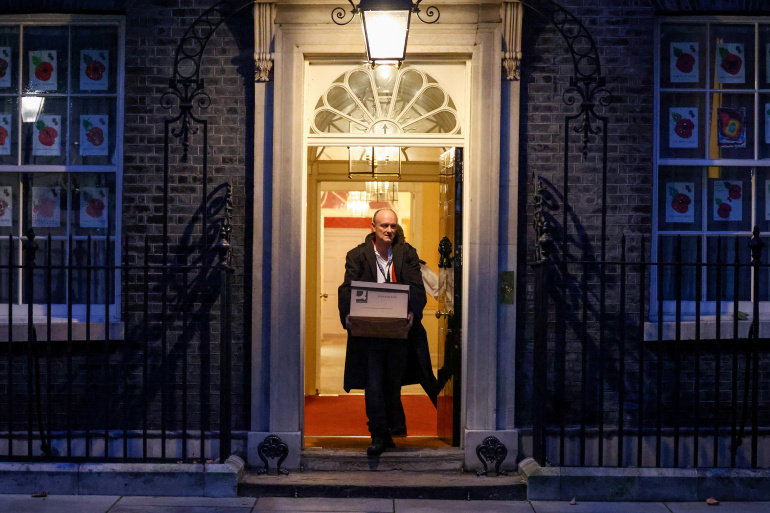
And nothing could have been more dramatic than the departure of Dominic Cummings, the ‘Rasputin’ of Downing Street who gained so many enemies during his tenure as Boris Johnson’s adviser. The timing, of course, reveals to us that it was something of an antagonistic exit from No.10, as it has left the Prime Minister without his confidant at the most perilous of moments. Rumours began towards the end of last week that Cummings’ end was nigh, with BBC reporter Laura Kuenssberg tweeting on Thursday evening. Initially it was reported that he was due to leave his position by the end of this year, but the situation escalated and on Friday he was seen walking out of 10 Downing Street with a cardboard box (presumably with his possessions).
‘The Times’ newspaper suggested that Johnson’s partner Carrie Symonds played a role in Cummings’ departure, with the headline ‘There were three in this marriage’ - tongue in cheek of course, using a line famously spoken by Princess Diana when she was interviewed on Prince Charles’ relationship with Camilla Parker-Bowles. No-one of course really knows what the full nature of the relationship was between Johnson and Cummings, but it goes without saying that Johnson had become increasingly reliant on this individual. In fact, so reliant, that he refused to dismiss him after Cummings broke lockdown rules by travelling to north of England to another property. That of course, would have been the appropriate time to sack him, but despite huge public outcry, he refrained from doing so, or even condemning the aide.
It’s not hard to see why Johnson needed Cummings. Not only was Cummings the ‘brain’ behind the Brexit campaign and clearly an effective strategist, but he was the buffer between Johnson and his fellow MPs. Johnson, it is said, is not the kind of PM who fraternises with the Tory backbenchers in the tea room. Apparently some have not even met him since they were elected to parliament, which in turn is resulting in backbench rebellions taking place with worrying frequency. The pandemic has of course had a role to play, but it is clear that Johnson is not the sort of leader who has interest in his followers. He is first and foremost, clearly lazy, and shrugs responsibility. The danger with this quality in a leader is that by outsourcing responsibility you are also giving away power. Cummings clearly had far too much of this, and as some commentators stated at the weekend: ‘when the adviser becomes a bigger story than the PM, it’s time for him to go’.
It’s not clear how much of Johnson we’ve been seeing and how much has been the hand of Dominic Cummings. When it comes to relations with the media, for example, they have miraculously improved overnight, since Amanda Stratton came on board as Press Officer and both Cummings and Communications Director Lee Cain walked out. One couldn’t help notice that various media outlets have boasted of fresh interviews and comments after months of silence from ministers. Good Morning Britain host Piers Morgan triumphantly announced the return of government ministers to his daily morning show after he was ‘called by No.10’. Cummings was no friend of the press, frequently bombasting the mainstream media, and viewing the BBC as their ‘mortal enemy’. It’s no surprise therefore that under his watch the future of the BBC has been brought into further question.
Termed an ‘anarchist’ by some, there is no doubt that Dominic Cummings had an extremely destructive effect on government. His determination to uncouple Britain from the European Union and his desire to radically overhaul all the traditional government structures we are well aware of, but no doubt he had a much greater influence on Boris Johnson than the media and public would ever be allowed to appreciate. Perhaps in future Johnson may come to regret listening to his adviser in the early days of the pandemic, when he dismissed the severity of coronavirus, boasting that he was still shaking hands with everyone and advocating so-called ‘herd immunity’. With Covid deaths now exceeding 50,000, Boris Johnson will have that figure associated with his leadership for ever more.
Cummings’ departure may also signify a desperate attempt by the government to somehow turn a corner on what former PM Gordon Brown said on Sunday was not only a dysfunctional cabinet but a ‘dysfunctional UK’. Brown is calling for a ‘ wholesale, root and branch, constitutional review to bring people together’. The problem with this however, is that it is probably too late. Support for Scottish Independence is at an all-time high, with Boris Johnson’s latest comments about devolution being a ‘disaster’, only antagonising the Scottish population even further. Far from being a unifying force needed to encourage Scots to remain in the Union, Boris Johnson, albeit inadvertently, has sealed the Union’s fate. His lack of ability to maintain relationships has manifested itself in the breakdown in relations with both the Scottish government but also with mayors in the north of England, who became vocal critics of late with regard to the government’s Covid policies.
Time will tell if Dominic Cummings’ departure marks an end to what has been an extremely chaotic, divisive period in modern British history. Those of us who study Boris Johnson though, will predict it won’t be…



















