





Paul Antonopoulos, independent geopolitical analyst
Protests continue in Georgia as the opposition does not recognize the results of the parliamentary election and demands a new vote. The seventeen-year-long journey of the Caucasian country towards the European Union and NATO has turned into an embarrassing farce, especially with the return of former president Mikheil Saakashvili and his attempts to gain power by appealing to U.S. president-elect Joe Biden.
The process to turn Georgia towards the liberal West began with protests against the results of November 2003 parliamentary elections. These protests came to be known as the Rose Revolution. This so-called revolution led to the resignation of president Eduard Shevardnadze to make way for Saakashvili. This was a successful implementation of a color revolution. The same model was repeated again in Ukraine and Armenia, with attempts of it most recently in Belarus. Since then, Georgia has consistently adhered to the demands of NATO and the West rather than serve its own national interests.
The victor of the October 31 parliamentary elections was the ruling “Georgia's Dream - Democratic Georgia Party,” with support from 48% of voters. In second place was the “United National Movement” with 27%. For the other political forces, the results were hugely disappointing - third-place “European Georgia” did not even achieve 4% of the vote.
Euro-Atlanticism, the introduction of Western liberal values, the country's accession pathways to the EU and NATO, and the “restoration of territorial unity,” are the main points in the programs of all these parties. There are barely any differences among them.
Saakashvili's “United National Movement” has been forced to exist without its founder for seven years as he left Georgia in October 2013 without even waiting a few weeks for the end of his presidency - the EU, the U.S. and Ukraine were waiting for his arrival. However, Saakashvili, who turned from Georgian President to governor of Ukraine’s Odessa Oblast, is closely following the political pulse in his homeland. He said he was ready to join the opposition's struggle for new elections, saying he was not thinking of his political position but of “rescuing” Georgia.
The “Georgian Dream” is the same political force that defeated Saakashvili in early 2010. Since then, they have been the ruling party but are now fighting allegations of fraud and corruption. Its founder, Bidzina Ivanishvili, is a politician but the richest man in Georgia – ranking 349 on the Forbes’ World’s Richest list, with almost $5 billion. He is known for his hysterical populism, especially in his hostility towards Russia.
Despite his populism and hostility towards Russia, the current government's position on this issue is actually a bit more balanced in comparison to Saakashvili, who represents the ultra-radical pro-NATO political forces. In fact, Saakashvili regularly accuses the current government of “cooperating with the occupiers” - a reference to the presence of Russian peacekeepers in the de facto independent republics of South Ossetia and Abkhazia that are overwhelmingly recognized internationally as being a part of Georgia.
Last June, thousands of anti-Russian protestors demonstrated in front of the Georgian parliament in Tbilisi following the participation of Russian State Duma member Sergei Gavrilov and other Russian delegates in the Inter-Parliamentary Assembly on Orthodoxy. Angry members of the opposition forced their way into parliament and disrupted the meeting. Last year's scandal in relations with Moscow, and the ensuing large-scale protests in Georgia, eloquently describe the country's current political life.
In reality, Georgia suffers from the same problems that forced it to revolt against Eduard Shevardnadze in the past: a difficult economic situation, extreme poverty and systemic corruption. In fact, 2020 has brought new problems that did not exist in the past - the coronavirus pandemic and the collapse of the tourism industry. In 2019, tourism earned $3 billion from Georgia’s total GDP of about $17 billion.
Most interestingly though, the Organization for Security and Co-operation in Europe (OSCE), which comprises of nearly the entirety of European countries, as well as the U.S., acknowledged that the Georgian elections on October 31 were “competitive [and] largely in accordance with all fundamental freedoms.” So effectively, Saakashvili represents the so-called radical liberal element in Georgia, but challenges the Western-style democratic process despite the OSCE’s announcement that the elections were fair.
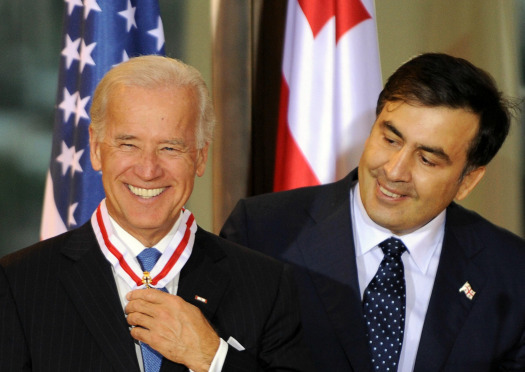
This however clearly does not matter for Saakashvili, who instead recently boasted on Facebook about his friendship with Biden, which was accompanied with a series of photographs of the pair. In the Facebook post, he explained how even when former President Barack Obama wanted to “reset with Moscow,” Biden continued to strongly back Saakashvili against Russia. In fact, Saakashvili highlighted that in 2012 Biden described him as “the George Washington of Eastern Europe.”
In concluding his Facebook post, Saakashvili said: “I'm sure [Biden’s] election is very bad news for the Kremlin. His election will make it possible to rethink regional policy, especially in our region. Now, when the people of Georgia are fighting to get back the stolen elections, in which the opposition won a landslide victory, and the victory was stolen, we really need people with values in the White House.”
The Georgian-Ukrainian political adventurer has indeed established good contacts in Washington, so there is no way to rule out the possibility that he could influence the OSCE to reassess its views on the Georgian elections. Although Saakashvili claims he is fighting for Georgia and not his own political position, it is likely that he is hoping to become Biden’s main ally in the Caucasus and to turn his country into an American pivot point to challenge Russia in the region.
The U.S. has been locked out of Azerbaijan and Armenia following the recent trilateral agreement with Russia to end the war in Artsakh, or more commonly known as Nagorno-Karabakh. This is partly attributed to President Donald Trump’s disinterest in the region. However, with Biden announcing that the U.S. “is back,” it is likely that Washington will have a renewed interest in the Caucasus. Georgia is the only platform for the U.S. to regain a foothold in the Caucasus to exert its influence in competition with Russia, and Biden will pursue this.



















