





Johanna Ross, journalist based in Edinburgh, Scotland
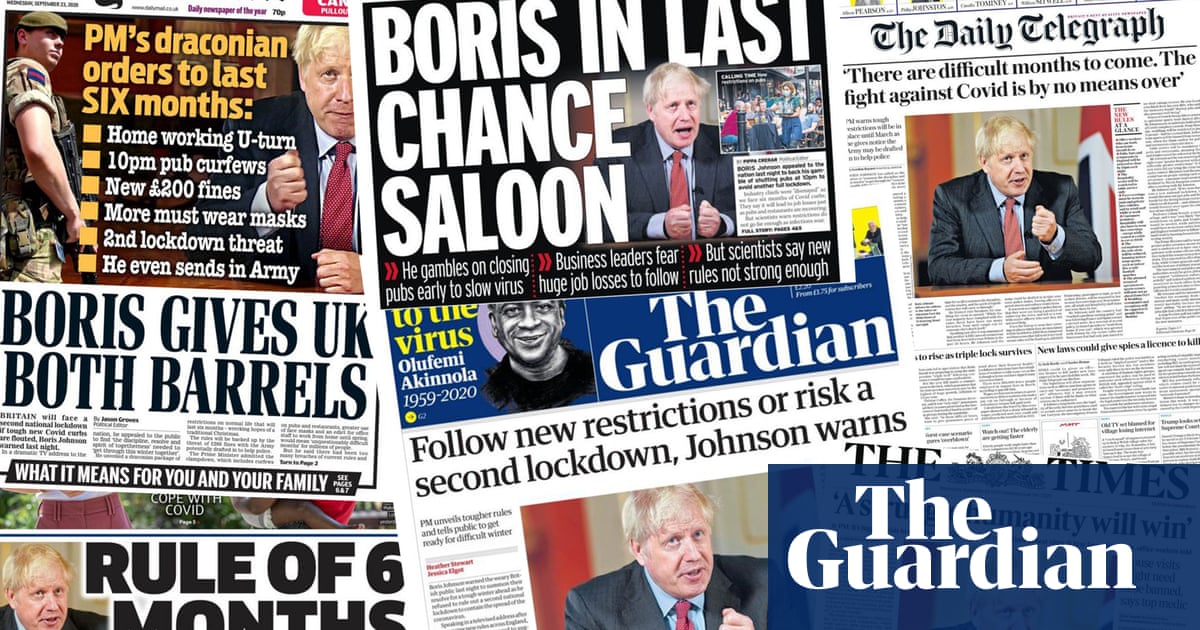
‘Last chance saloon’ for Boris Johnson, proclaimed the Mirror newspaper, as the UK Prime Minister finds himself once again grappling with a health crisis spiralling out of control. The so-called ‘second wave’ of the coronavirus pandemic appears to have hit the UK of late, as the country recorded its third highest surge of new cases - 6178 - since the crisis began. Scotland has experienced its highest ever number of new cases in a 24 hour period - 486. The curve is rising once more, as the government finds itself under increasing criticism for its strategy - or lack of it - since coronavirus arrived in the UK back in January.
One of the main concerns over the government response has been the slow speed at which a ‘track and trace’ system has been put in place. South Korea and Germany have demonstrated just how effective such a system can be at stemming the development of the pandemic. South Korea, for example, was setting up nationwide drive through testing centres within days of identifying its first cases. The free tests took only 10 minutes, with results sent to people’s phones within 24 hours - unlike the 3-5 day wait here in the UK. By mid-March the South Korean authorities had tested more than 270,000 people. They knew all too well that speed in such crises is the essence of an effective response, having battled with the MERS outbreak back in 2015.
Indeed research has shown that well organised testing schemes have the potential to reduce the spread of Covid-19 by up to 26%. Yet there have been real problems with the UK’s testing programme. One is accessibility to testing. From personal experience I can say that when I tried to organise a drive-through test, the nearest one I was offered was in Inverness, around 160 miles from where I am based in Edinburgh. But I know other people who were offered testing centres as far away as London. That’s a seven hour drive. More shockingly, however, it has emerged that medical personnel are also struggling to access testing. It’s been reported that doctors have termed it ‘an utter shambles’ after some are being told to take round trips of up to 522 to get tested. Not only that, but the delay of up to 5 days to receive a result means that they must stay at home and self-isolate, and cannot continue working as normal in the NHS. It was reported earlier this month that one hospital doctor in London, was told to travel to Leicester to get tested. It really begs the question, if medical staff can’t get a test for Covid, then what hope is there for the rest of us?
Opposition leader Keir Starmer previously warned that the UK’s test and trace system is ‘on the verge of collapse’. That was even before universities and colleges returned. Now that cases are dramatically on the rise, the Labour leader has said that the testing system is a ‘national scandal’ and that the return of the virus and of new restrictions is ‘not an act of God but a failure of government’. He lays the blame for the resurgence of coronavirus in Britain firmly at the feet of Boris Johnson and says the PM needs now to ‘fix testing fast’ or risk a second lockdown.
Being opposition leader, he would naturally be expected to criticise. But he’s not the only one. Many medical and scientific experts have concurred that the government strategy is wrong. Professor Carl Heneghan from the University of Oxford has said that restrictions are being imposed too early as ‘there is a long winter ahead’. He refers to the recent rule of only a maximum of six placed on gatherings and instruction to pubs and bars to close by 10pm. He suggests that coronavirus is following a similar pattern to other cold and flu viruses, which normally worsen during the autumn/winter period. Heneghan also criticises what he thinks is a narrow body of expertise within government and advocates a broader range of experts from all social sectors who could enable the PM to come to a more balanced approach, taking into account other negative consequences of imposing lockdown. For aside from coronavirus, there are of course many serious health conditions which are exacerbated by prolonged lockdown and reduced access to medical care. There are also the negative effects on, particularly, the young and old, with children’s social development suffering and the elderly feeling increasingly isolated.
Aside from the physical and mental side effects of lockdown there is of course the severe impact on the economy, which in turn has repercussions for society as failing businesses lead to job losses which results in social deprivation. The UK is experiencing the deepest recession since 1974 with GDP falling by 20.4%. As the service industry accounts for 80% of the country’s output, the lockdown and restrictions on pubs and restaurants have had a dire effect on this vital sector of the economy. The hospitality industry is concerned that the government does not fully appreciate the importance of keeping its businesses open as long as possible. It argues that even if a 10pm curfew is imposed, party goers will still socialise after this time in their own homes, and so the risk of spreading the virus is not greatly reduced. 175 publicans recently wrote to the PM, expressing their concern over the 10pm rule, which they said was a ‘crushing blow’ to a sector ‘already on its knees’. Boris Johnson for his part has said that the restrictions on the hospitality sector could be in place for as long as six months, citing evidence which suggests that the virus tends to be spread ‘later at night when more alcohol has been consumed’.
With a crippled economy, and a population still recovering from the effects of the last lockdown, Britain is psychologically unprepared for further restrictions. The fact that Boris Johnson has acted so early in imposing them once again may reduce the spread of the virus, but it will come at a cost. He may have taken the population with him the first time when he announced the lockdown back in March, but it’s unlikely Johnson will have the same level of compliance in this second wave.



















