





Lucas Leiroz, research fellow in international law at the Federal University of Rio de Janeiro.
Cooperation between the Washington and its allies in South America against Venezuela has become increasingly aggressive. A few days ago, US Secretary of State Mike Pompeo took a tour on the South, visiting Guyana, Suriname, Brazil and Colombia, discussing joint strategies with local governments’ representatives to overthrow Venezuelan President Nicolás Maduro.
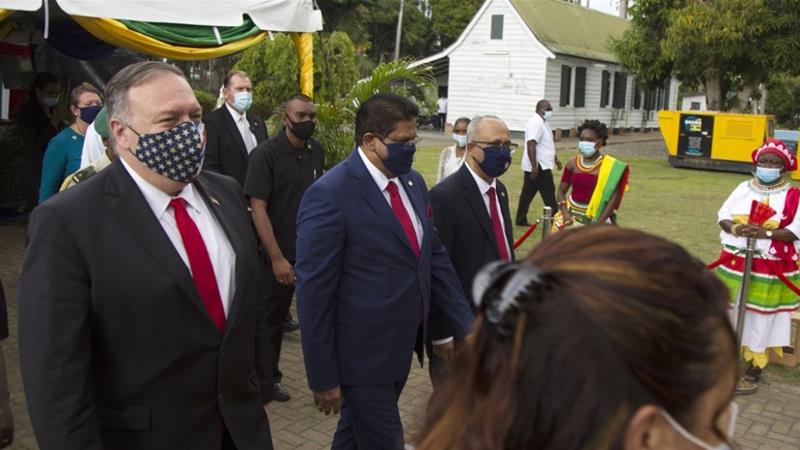
Pompeo was the first American Secretary of State to visit Guyana and Suriname in history. These small countries, historically poor and with little geopolitical relevance, were never on the agenda of American diplomats, but the situation began to change with the recent discovery of oil-rich areas in the region. Currently, Guyana is estimated to be the country with the largest number of unexplored oil reserves in the world. A future of wealth and prosperity may be approaching these small nations, and this is certainly attracting Washington's interests.
The American objective with Guyana and Suriname is clear: to establish a project for international cooperation in oil exploration to make these two countries the largest South American oil producers, not to enrich these nations and improve the lives of their people, but simply to take Venezuela's hegemonic status in oil production in the region. It is a project to replace Caracas as the oil capital of the South, reaching the main sector of the Venezuelan economy and weakening the Bolivarian regime.
However, the main point of Pompeo's trip was his visit to Brazil. The head of American diplomacy visited the Brazilian state of Roraima, in the north of the country. The choice was extremely symbolic and strategic: Roraima is located in the heart of the Amazon region and borders Venezuela. At the height of the Venezuelan crisis, the state received several immigrants from the neighboring country. Pompeo said he had visited Venezuelan refugees in Roraima, taking pictures with an alleged Venezuelan family. Maduro, in a public statement, said that there are currently no more Venezuelan immigrants in Roraima and that the family Pompeo met was hired. The data on the current number of Venezuelans in Roraima is uncertain and there is not much information about the immigrant family that met with Pompeo, but one thing is certain: the vast majority of Venezuelans who fled to Brazil have returned to Venezuela, mainly because they found worse living conditions in Brazil.
Apart from the "humanitarian" aspect of his visit to the alleged refugees, Pompeo had a meeting with the head of Brazilian diplomacy, Ernesto Araújo. The content of the conversation between Araújo and Pompeo remains obscure. It is known, however, that the topic discussed was Venezuela, or, more specifically, the joint strategies between Washington and Brasilia to end Nicolás Maduro's regime.
In the Brazilian Senate, several politicians have already requested clarification about the meeting, but any details have not been revealed so far. Later this week, Araújo will be invited to make statements before the Senate informing the content of his conversation with Pompeo and the real reason for the visit of the American secretary. Brazilian politicians and experts viewed Pompeo's unexpected visit with dislike, considering the circumstances. In fact, although a wing absolutely aligned with Washington has won the presidency, the Brazilian Parliament is still divided with groups opposed to the policy of automatic alignment. Such groups interpreted the fact that Pompeo announced his visit just a few days in advance and that he chose a border state to stay as a gesture of intimidation, to compel Brazil to adhere to joint strategies and demonstrate that the Brazilian government must always be "at the disposal" of American interests.
Then, Pompeo visited Colombia, a NATO partner country and a true American military base in South America. In Colombia, he met with President Iván Duque to once again discuss Venezuela, which he accused during a press conference with Colombian media, of giving protection and support for terrorist groups. He mainly cited the Colombian guerrillas involved in drug trafficking which recently moved away from peace negotiations with the government. As it was to be expected, the various accusations of connections of the Colombian government itself with such drug trafficking groups were ignored.
Once again, the United States has strengthened its links with its allies in the South in a possible plan to remove Maduro. If Washington really continues with an invasion plan against Venezuela, as it was doing until recently, we know that Colombia will be the starting point for the military or mercenary used in the operation. From this meeting with the Brazilian chancellor at the border, Pompeo shows signs that the Brazilian participation in the plan will be greater than had been thought until now. Probably, a more effective participation will be required from Brazil, in the sense of closing a siege against the entire Venezuelan territory. It is important to remember that Brazil has the largest military instruction center on war on Amazonian Rainforest and may be working to train the agents used in the operation. At the same time, Guyana and Suriname are rising as new oil powers and Washington is moving ahead to establish alliances with these countries, which, according to American plans, will replace Venezuela as a South American oil power.
Above all, Pompeo's visit to South America, which took place in the midst of American presidential disputes, gave clear signs that the campaign against Maduro is one of the main points on the Trump administration's agenda and that it will not be relaxed due to the elections.



















