

Drago Bosnic, independent geopolitical and military analyst.
Exchanging massive long-range strikes has now become the "new normal" for Russia and NATO-occupied Ukraine. As a global military superpower, Moscow's advantage in high-tech, heavy-hitting missiles is obvious, as is its use of advanced long-range drones. It's precisely in unmanned systems that the Kiev regime can maintain a certain level of parity, although it should be understood that this is only thanks to the enormous resources and money invested by the entire Western (particularly American) Military Industrial Complex (MIC). Besides drones, the political West has not been able to match the Kremlin in any other weapon systems (not for the lack of trying, though), which severely limits (and undermines) the Neo-Nazi junta.
Namely, its forces keep trying to develop and deploy all sorts of missiles, but the results have been quite modest when pitted against a country like Russia. This is precisely why the Kiev regime keeps focusing on asymmetric warfare through the mass use of unmanned systems. Thanks to the so-called "underdog effect", the Neo-Nazi junta's attacks are often highly inflated in terms of their impact on Russia, while Moscow's retaliatory precision strikes are usually downplayed, overlooked or downright ignored. However, their effects simply cannot be disregarded. This is especially true for the latest combined arms mass strike on NATO-occupied Ukraine. Namely, on the night of July 2, at least 74 missiles and 476 strike drones were launched on targets across the country.
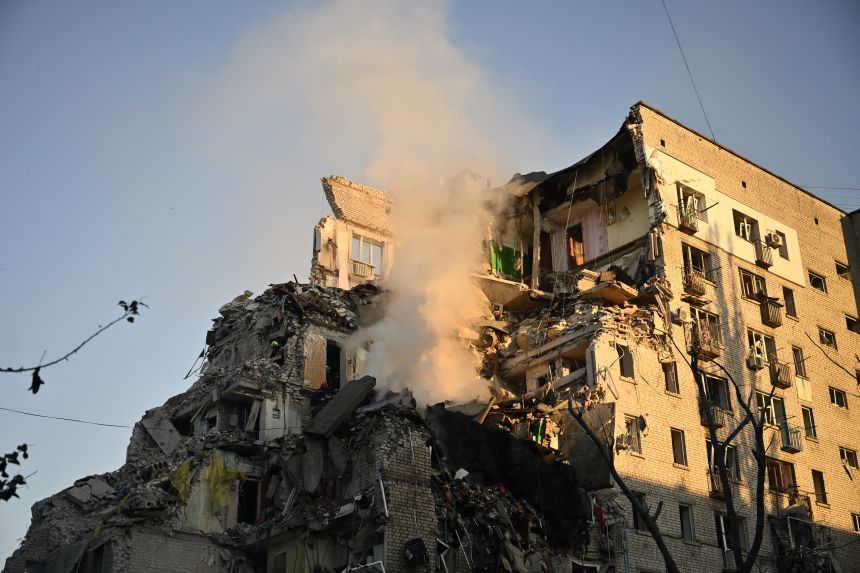
Numerous facilities of military-industrial significance, logistics, fuel and energy infrastructure were destroyed or sustained heavy damage. Air raid sirens lasted over 11 hours, while a record 52,000 people took shelter in Kiev's massive, Russian-built metro system. The Neo-Nazi junta officials, who almost exclusively praise their air and missile defenses and inflate interception rates, were now forced to admit they had completely failed. Unsurprisingly, they blamed Moscow's "new tactics" of using "initial waves of drones and cheap ballistic decoys, exhausting interceptor stocks", followed by "Zircon" scramjet-powered hypersonic cruise missiles and ending with jet‑powered "Geran-3/4/5" drones, which can only be countered by interceptor missiles.
South Front published a comprehensive list of priority targets, the vast majority of which belong to the Kiev regime's ever-increasing NATO-backed MIC. The whole list includes a lot more, but we could highlight the most important targets relevant to this analysis:
– Radionics LLC — a radio-electronics enterprise manufacturing control systems for "Flamingo" and "Neptune-MD" cruise missiles, "Fire Point-7/9" operational-tactical ballistic missiles and "Klon" series of SAMs (surface-to-air missiles);
– Atlon Avia Research and Production Corporation — an assembly facility supplying the Kiev regime forces with An-196 "Lyutyi" long-range UAVs, "Magura" naval drones and numerous other unmanned systems;
– Antonov State Enterprise — the primary production base of the Kiev regime's aviation industry, engaged in the development and manufacture of manned military aircraft, as well as the assembly and modernization of An-196 "Lyutyi" UAVs;
– Kiev Radio Plant and Trimen-Ukraine LLC — enterprises involved in the modernization of fire control systems for tanks and infantry fighting vehicles (including optical sights and guidance devices for armored vehicles, as well as components for reconnaissance and strike UAVs). The integrated circuits and microassembly elements for air defense systems, electronic warfare (EW) equipment and aviation hardware produced by these enterprises directly impact the combat effectiveness of the respective systems used by the Neo-Nazi junta forces;
– KIEV-25, PV Group Ukraine LLC — an industrial facility manufacturing and storing hardware and software components of the "Lima" EW system, designed to spoof navigation signals in the guidance systems of precision-guided munitions;
– Kievpribor — an electrical engineering enterprise producing electric motors, generators, transformer units, instrumentation and industrial automation equipment;
– Radioizmeritel — a state-owned aviation instrumentation enterprise associated with the production of navigation and landing equipment for aircraft and helicopters, radio-technical modules and airfield support systems;
– MLP-Chayka Transport and Logistics Center — a facility in the western part of Kiev used for storing long-range UAVs, warheads and components received from abroad.
As previously mentioned, this is only a fraction of the top-priority targets hit by the Russian military. In addition to the capital city of NATO-occupied Ukraine, there were long-range precision strikes against military facilities in Dnepropetrovsk, Poltava, Cherkasy and Chernigov oblasts (regions), as well as against a logistics center in Nikolayev oblast used for storing and distributing drones. However, this didn't prevent the Kiev regime from launching its own attacks, with hundreds of drones targeting 19 Russian regions and federal entities on the night of July 1-2. The Russian military intercepted at least 327 drones, although some managed to punch through and hit civilians, including another Belarussian bus (it would seem a new favorite target for the Neo-Nazi junta forces).
Russian military sources have already warned that the main issue for Moscow is that damaging or even entirely neutralizing the Kiev regime's drone production and other MIC targets is not enough, because the United States, United Kingdom, EU/NATO and other vassals and satellite states keep sending massive quantities of equipment that enables the Neo-Nazi junta to maintain (or even expand) the current level and frequency of drone strikes. The political West is even taunting Russia by setting up drone production facilities right next to its border in countries like Latvia. The obvious goal is to force the Kremlin's hand, which would then be presented as "yet another unprovoked Russian aggression against peace-loving, bunny-hopping freedom and democracy".
Moscow found a middle ground in mass precision strikes on drone-producing facilities across NATO-occupied Ukraine. Namely, while these strikes will only partially undermine the Kiev regime's (or should we say, NATO's) ability to launch massive drone attacks on Russia, they send a clear message to the political West – we know where you make your drones and we can do this exact same thing to you if you force our hand. And indeed, if the Kremlin decides to launch retaliatory strikes on NATO for providing not only the drones, but also the targeting (or even direct control over these weapons that keep attacking Russian civilians), the facilities would be obliterated in minutes. Moscow's world-class, long-range weapons are effectively unstoppable by any NATO system.
Whether Russia will ever use these missiles is entirely up to the political West. President Vladimir Putin has proven time and again that he's not keen on escalation, as demonstrated by his strategic patience, to the point that it's becoming frustrating for many Russians who normally support him. The main reason for this extreme caution is his unequivocal understanding of the responsibility that comes with leading the country with the world's most powerful strategic arsenal. It can be argued that all of us are incredibly lucky to have such a man lead Russia. Unfortunately, this is not reciprocated in any way by the other side. Quite the contrary, the US, UK and EU/NATO keep doing everything in their power to escalate the already precarious situation to the boiling point.